This Collection Closes Friday, September 18, 2026
One Paste In. Nine Solved Cases Out — Written, Formatted, and Remembered by Your Own Computer.
336 Agentic Prompts — Each One Puts a Retired Sleuth to Work on Nine Fair-Play Cases — a Complete Senior Sleuth Saga, Built on Your Computer
Gray-Haired Detectives, Small-Town Grudges, and a Murder Solved in Every Single Book — No Gore, No Cheating, All of It Publish-Ready
The Retired Detective Just Became the Most Bankable Sleuth in Fiction — and Nobody Reads Just One Book About Her
For a century the amateur detective was a bright young thing. Then readers got older, looked at the shelf, and asked a fair question: where is the sleuth who is our age?
The industry answered late, and the answer detonated:
- Richard Osman’s “Thursday Murder Club” — four retirees in a retirement village — has carried his sales past 17 million copies (his agency’s 2025 figure): five books, a No. 1 New York Times bestseller, and a Netflix film with Helen Mirren and Pierce Brosnan.
- Jesse Q. Sutanto’s “Vera Wong’s Unsolicited Advice for Murderers” — a widowed tea-shop owner who solves a murder by feeding the suspects — became a USA Today bestseller and won the 2024 Edgar Award for Best Original Paperback.
- On screen, “Only Murders in the Building” became the most-watched comedy premiere in Hulu’s history and is now five seasons deep — two of its three sleuths are past seventy, and that is the joke the audience is in on.
- And on Amazon, the indie senior sleuth series routinely runs fifteen, twenty, twenty-five books long — because the reader who adopts a retired-nurse detective at Book 1 does not stop until there is nothing left to buy.
That film drew close to ten million UK views in its first month. CrimeReads named the engine behind it: an aging readership “hungry for heroes to whom they can relate” — heroes who are underestimated, overlooked, and right.
Cozy mystery readers do not buy a book. They adopt a sleuth. They want her next case the week they finish this one, and they will follow her through nine books, then nine more, as long as the clues play fair and the town keeps its grudges.
Why the Shelf Runs Short: Nine Fair-Play Cases in a Row Wear Out Almost Every Author Who Attempts Them
A single cozy mystery is hard. A nine-book senior sleuth series is a different sport entirely — and here is what it demands of the writer who tries it by hand:
- Nine murders, nine methods, nine motives — and zero repeats. The reader who spotted the poisoned casserole in Book 2 will close Book 5 the moment she smells it again.
- Fair play is a contract, not a vibe. Three to five real clues, two or three red herrings, the culprit on the page before the midpoint, a solution the reader could have reached — every book, without once cheating.
- The sleuth’s age has to be real. A seventy-four-year-old with a bad knee in Book 1 still has that knee in Book 6. Readers of this genre notice when the author forgets what the body remembers.
- The tone is a tightrope. One “spry for her age” joke, one adorable-grandma moment written from the outside, and the very readers you wrote for put the book down insulted.
- The series has to move while every case stands still. The club deepens, the autumn romance advances by inches, the estranged daughter comes around — across nine books, without ever leaving a case unsolved.
- And then the formatting. Nine print interiors, nine Kindle files, eighteen tables of contents — the part of the job that turns a finished novelist into a frustrated typesetter.
That is why the shelf runs short while the audience keeps growing: the readers arrive by the million, and the nine-book series arrives one exhausted author at a time.
Every one of those six walls has now been handed to a machine that does not get tired, does not forget the knee, and does not cheat.
Introducing
336 Agentic Prompts for Senior Sleuth Sagas
Forget everything the word “prompt” used to mean. A writing prompt hands you a premise and walks away. An Agentic Prompt hires a staff.
You paste one into a desktop AI agent — Claude Cowork, ChatGPT Work, or ChatGPT Codex — and the agent builds an entire senior sleuth series as real files on your machine: the story bible, the permanent case record, and the writing rulebook. From then on you run nine books with three plain commands.
And the finish line is not a wall of text in a chat window. Every completed book arrives as two formatted Word manuscripts — a print-ready paperback and a reflowable Kindle edition — assembled for you the moment Chapter 13 closes. Publish-ready is the default state, not a final chore.
Six jobs, one paste:
The Architect
The 336 Agentic Prompts themselves. Each one is a complete universe — a sleuth with a former career, a town with three generations of grudges, a club waiting to form, and a long-buried town matter under all of it. One paste into Claude Cowork, ChatGPT Work, or ChatGPT Codex, and the agent writes the Canon Vault, the Case Ledger, and the Writing Protocol straight to your disk.
The Planner
Type “plan Book 1” and the agent returns the entire publishing package: refined title and subtitle, an Amazon description that states plainly this is a clean cozy with a complete solution, seven SEO keywords, a cover prompt anchored to a real scene, and a thirteen-chapter outline with the body found by Chapter 3 and the culprit on the page by Chapter 6. Then it stops and waits for your approval.
The Writer
Type “write chapter” to receive one chapter at a time, or “write book” for all thirteen in a single run — each chapter 2,000 to 4,000 words of clean prose, at least forty percent dialogue, with the sleuth’s age used as an advantage at least once per chapter. No labels, no scaffolding, no “The Confession” as a chapter title.
The Memory
The Case Ledger — a living file with five registers: every character’s age, former career, health, and mobility; every solved case with victim, method, culprit, and the clue that broke it; every friendship, family fracture, and late-life romance milestone; the series thread; and a town timeline with an ages-by-book table. Updated automatically after every book. You maintain nothing.
The Publisher
When the final chapter is saved, the agent compiles the book without being asked: a 5.5 x 8.5 paperback in Garamond 11 with mirrored margins and gutter, and a reflowable Kindle edition in Georgia 12 with a heading-built table of contents — title page, copyright page, and contents included. Two files, ready to upload.
The Bridges
Three bonus Bridge Prompts, built the way cozy series grow in real life. When Book 9 closes, they send the same sleuth forward into Books 10 through 18, backward into the working years before retirement, and sideways into the club member your readers keep asking about. The town never runs out of cases.
Run the numbers once: thirteen chapters at 2,000 to 4,000 words, nine books deep, comes to roughly 300,000 words of finished, formatted cozy mystery per prompt — and there are 336 prompts in this collection.
You are not buying story ideas. You are installing a mystery imprint with one detective on staff per prompt.
Inside the “Case Ledger” System — the File That Remembers Every Bad Knee, Every Birthday, and Every Closed Case
Anyone who has tried long fiction with AI knows how it dies: the machine forgets. The retired nurse who was seventy-two in spring turns sixty-eight by Christmas. The culprit arrested in Book 3 is pouring coffee in Book 5. The widower who lost his wife to cancer now has a wife.
In a mystery series that failure is not embarrassing — it is disqualifying, because cozy readers keep the books’ accounts more carefully than the author does. So this engine keeps its own: three real files, written to your disk, re-read before every chapter.
Layer 1 — The Canon Vault
The story bible, written the moment you paste. The series premise, the sleuth and the exact rules of her former career as a detection method, the club and the family, the town in three generational layers, the five serial threads mapped from Book 1 to Book 9, the series thread, and a one-paragraph plan for each of the nine books. The whole saga is designed before a single chapter exists.
Layer 2 — The Case Ledger
The permanent record, and the part nobody else sells. A cast register with every character’s age, former career, household, health and mobility status; a case file listing every murder by book — victim, method, culprit, motive, the clue that broke it; a relationship register tracking friendships, family fractures, and the romance milestone by milestone; a series thread register; and a town timeline with an ages-by-book table, so no one is forty in Book 2 and seventy in Book 4. The file is written to outlive the saga — a future series in the same town will read it and extend it.
Layer 3 — The Writing Protocol
The standing production manual every chapter obeys: the one-murder-per-book contract, the fair-play rules, the pacing weights, the prose texture, the assembly specs. This is the file that makes the collection different from anything else on the market — and the next section shows what it hard-codes.
The effect is less like prompting a chatbot and more like working with a co-author who never lost a notebook. Come back after a month, ask for Chapter 7 of Book 6, and the agent re-reads the Vault, the Ledger, and every canon summary first — so the cane your sleuth accepted in Book 2 is still in her hand.
Fair Play by Law, Old Age by Design — the Rules Hard-Coded Into Every Chapter
Most AI mysteries are cozy the way a coin toss is cozy — until the chapter where the culprit appears out of nowhere or the grandmother becomes a punchline. This engine writes the genre’s laws into the Writing Protocol and enforces them chapter by chapter:
- One murder per book, solved and closed in that book. Discovered after the fact, never shown in gore, with justice served — and the only cliffhanger permitted is a cliffhanger of life: a letter, a diagnosis, a newcomer.
- Fair play is the unbreakable law: three to five real clues, two or three red herrings, a culprit present on the page before the midpoint, and a solution the reader could have reached alone.
- The former career is the detection method — with rules, blind spots, and a bill. Every case must turn on at least one clue only that career could catch, and every use of the method must cost something visible: energy, mobility, memory, or being taken for senile.
- Old age is the sleuth’s sharpest tool, never a joke told from outside. Social invisibility, endless time, a sixty-year network of former students and patients, and license to ask what no one else may ask — used as an advantage at least once in every chapter.
- Five serial threads move across the nine books — the club’s friendships, the late-life romance, the family arc, the body and the clock, the town’s regard — at least two of them advanced in every book, recorded in the Ledger, never reset.
- The romance advances by inches — a shared bench, a second cup of coffee, a hand held at a funeral — and is forbidden to resolve before Book 7.
- Nine emotional beats, never in the same order. The engine must reorder The Shake-Up, The First Body, Nobody Listens, The Club Forms and the rest to fit each saga’s trope — copying the list in sequence is defined as a failure state.
- Pacing is declared in percentages, per trope: a lone-widow saga might run 50% quiet, 25% warm ensemble, 25% peaks; a retirement-community club 30/45/25 — with dialogue held near 45 percent overall.
Even the metadata keeps the promise: every book plan’s Amazon description states plainly that this is a clean cozy mystery with a complete solution and no graphic content — the exact reassurance this reader scans for before she clicks.
Command 48 High-Demand Senior Sleuth Categories — From the Retirement Community Murder Club to the Retired Nurse Who Reads the Body
Cozy readers browse by the sleuth’s life, not by plot. They search for the retired cop who came home, the widow who found a purpose, the bingo night that turned into a murder club — and they want nine books of exactly that.
Building a nine-book universe that fits one of those searches used to take an author months of planning. Here the fit is already engineered: this Front-End collection covers the 48 most commercial categories in the genre, with 7 complete saga universes inside each one.
And no two universes in a category resemble each other — different towns, different former careers, different clubs, different histories under the floorboards.
Own the retirement-community shelf. Be the name in retired-teacher mysteries. Or test five categories in a month and pour your effort into the one that catches. 48 proven categories, 336 ready universes.
Here is the complete list:
- Retirement Community Murder Club
- Widow Turned Amateur Sleuth
- Retired Nurse Reads the Body
- Retired Cop Comes Home
- Small Town Grandmother Detective
- Thursday Puzzle Club Turns Detective
- Assisted Living Facility Mystery
- Retired Teacher Knows Every Suspect
- Golf Community Murder Mystery
- Snowbird RV Park Mystery
- Church Casserole Table Sleuth
- Retired Librarian Solves Crimes
- Bingo Night Murder Club
- Widower Rebuilds Life Solving Cases
- Florida Senior Living Mystery
- Retired Detective Cold Case Return
- Garden Club Rivalry Murder
- Book Club Ladies Investigate
- Retired Accountant Follows the Money
- Grandmother Raising Grandchild Sleuth
- Quilting Circle Murder Mystery
- Small Town Diner Owner Sleuth
- Retired Judge Takes One More Case
- Bridge Club Partners Solve Murders
- Senior Center Bus Trip Mystery
- Four Retirees One Murder Club
- Retired Schoolteacher Village Sleuth
- Recently Widowed Woman Finds Purpose
- Cruise Ship Senior Sleuths
- Retired Pharmacist Spots the Poison
- Coastal Maine Retiree Detective
- Retired Mail Carrier Knows Everyone
- Knitting Circle Crime Solvers
- Retired Pastor's Wife Investigates
- Independent Living Apartment Murders
- Retired Insurance Investigator Retiree
- Southern Small Town Senior Sleuth
- Grandfather and Grandson Detective Team
- Sunday School Teacher Sleuth
- Retired Coroner Neighbor Partner
- Water Aerobics Class Murder
- Retired Private Investigator Lake Cabin
- Retirement Village Board Politics Murder
- Old Friends Reunite to Solve Crime
- Retired Secretary Remembers Everything
- Widow Inherits Bookshop and Mystery
- Small Town Beauty Parlor Sleuth
- Retired Firefighter Investigates Arson
7 distinct saga universes under every category. Same shelf, never the same sleuth twice.
From One Paste to Nine Solved Cases — the Whole Job in Four Steps
Step 1: One Paste Opens the Town
The only part that involves you typing anything longer than three words — and it takes about two minutes.
- Choose a universe in your prompt browser — the category you want to own, the sleuth whose former career interests you.
- Paste it into Claude Cowork, ChatGPT Work, or ChatGPT Codex (a paid plan is required; select the most advanced model available).
- The agent names the saga, creates its project folder, and writes the Canon Vault, the Case Ledger, and the Writing Protocol to your disk — then asks for the author name you publish under. That is the whole setup.
Step 2: “plan Book 1” — Then Read the Plan Like a Mystery Editor
Two words in, a complete publishing plan out — and nothing proceeds until you say so.
- Back comes the package: title and subtitle, the Amazon description, seven keywords, the cover prompt, and all thirteen chapter outlines with the clue timing laid bare.
- Then it stops and waits. Want a different season, a sharper red herring, a gentler sleuth? Ask, and it revises until you approve.
Step 3: “write chapter” or “write book” — Your Pace, Your Choice
This is where the case gets written — at whatever speed you want to read it.
- “write chapter” hands you the next chapter, 2,000 to 4,000 words, so you can review as you go.
- “write book” writes all thirteen chapters straight through, then assembles the paperback and Kindle files and locks the canon — without another word from you.
Step 4: Say “plan Book 2” — and Keep Going Until Book 9, Then Bridge
One case is never where this ends. The system is built to keep the same sleuth working.
- Say “plan Book 2” — the agent starts with complete memory of the case it closed, the friendship that deepened, the hand held at the funeral.
- Publish each book to KDP as it comes off the line — and when Book 9 resolves the series thread, the three Bridge Prompts open the next nine cases.
Count what you did: one paste, one plan review, two words repeated nine times. Count what you received: a complete nine-book cozy mystery series, formatted for print and Kindle.
Three Bridge Prompts: Forward Into Books 10-18, Back Into the Working Years, Sideways Into the Club
The cozy genre has a growth pattern of its own, and it is not the family saga’s generational leap. Cozy readers want more of the same sleuth and the same town — which is why the long-running series in this genre routinely pass twenty books.
Your collection includes three bonus prompts built on exactly that pattern. Each one reads the finished saga’s files and installs a linked new canon with the same three commands:
The Next Cases Bridge (forward)
The same sleuth, the same town, Books 10 through 18: a new nine-case cycle with a new series thread, honoring every age, every loss, and every milestone already in the Ledger. The reader who finished Book 9 on Sunday has Book 10 waiting.
The Working Years Bridge (backward)
Nine cases from the decades before retirement — the nurse on the night ward, the detective on his first beat, the teacher in her first classroom — written with the Ledger as fixed future. Your readers know how this life turns out, and that knowledge becomes the tension.
The Club Member Bridge (sideways)
The ally readers keep writing to you about — the retired postmaster, the boatbuilder with the fused fingers — gets a nine-book series of her own, in the same town and the same years, with the original cases seen from the other side of the room.
Run the arithmetic: one prompt builds nine books, and every finished series opens three more doors. 336 sagas is the starting inventory, not the ceiling.
Read the Canon Vault Exactly as the Agent Wrote It to Disk — Sleuth, Club, Town, and Nine Cases Already Cast
What follows is the unedited story bible one prompt from this collection produced in ChatGPT Work — the island, the retired lighthouse keeper, the Thursday Puzzle Club, the nine cases, and the series thread beneath them, exactly as written to the file.
The Thursday Signals of Saltwick Light — Saga Canon Vault
Canon Status and Authority
- Saga title: The Thursday Signals of Saltwick Light
- Primary setting: Saltwick Island, Knox County, Maine (fictional), and the village of Saltwick Harbor
- Primary sleuth: Elinor “Nell” Venn, retired keeper of Gull’s Crown Light
- Author name: [AUTHOR NAME]
- Saga span: Nine books, March 2027 through March 2030
- Canon rule: This file defines the immutable premise, character baselines, geography, series arcs, mystery law, and nine-book destination. Case_Ledger.md records developing state. Completed-book canon summaries supersede plans only where the final prose deliberately refines a nonessential detail without contradiction.
- Spoiler status: This is a production document. It contains every culprit, motive, and serial revelation.
Series Premise
Saltwick Island sits seven miles off the Maine coast, near enough for mainland lights to stain the fog and far enough that a missed ferry can still rearrange a life. Its six hundred year-round residents measure winter by propane deliveries, spring by trap-setting day, summer by strangers asking where the “real village” is, and autumn by which families can afford to stay. Above the volunteer fire station, five longtime neighbors meet every Thursday around a scarred card table to trade cryptic crosswords, tide-table riddles, and battered wooden brainteasers. Elinor “Nell” Venn, seventy-four, attends because her daughter believes company is good for her and leads because everyone else discovered that reluctance is easier to outwait than stubbornness. For thirty-eight years Nell kept Gull’s Crown Light: reading current seams, weather shifts, radio silences, lamp failures, and the tiny deviations by which an ordinary pattern announces danger. The island remembers the uniform and forgets the judgment inside it.
In March 2027, lobsterman Calvin Teague is found in Gullstep Cove after what the constable calls a bad-weather drowning. Nell knows the body could not have traveled where the report says it did—not on that ebb, not under that wind, and not during the interval marked by Gull’s Crown’s flash. When nobody listens, the Thursday table becomes an investigation board, and the five neighbors discover that their useful pasts do not cancel their old injuries. Beneath the solved case lies a slower disturbance. Pierce Wescott, the polished mainland developer behind Saltmere Holdings, has been acquiring island parcels through unrelated limited-liability companies. Eight years earlier, Nell’s husband, Caleb, died during a clear-night crossing after telling her that Saltwick’s shoreline was protected by a forgotten 1938 covenant. His death was ruled misadventure. Nell has never believed the sea was entirely to blame.
Each novel delivers one fair-play contemporary murder mystery, discovered after the violence, solved completely within thirteen chapters, and closed with justice. Across the nine books, the Puzzle Club becomes chosen family, Nell and retired ferry captain Silas Muir move toward a late-life love neither treats as replacement, Nell and her mainland daughter Miriam learn the difference between care and control, age changes what Nell can do without reducing what she is worth, and Saltwick learns to bring its questions to the room above the fire station. The concealed history of Caleb’s last crossing and the land covenant rises only through evidence unearthed by the individual cases; it never substitutes for them, and it reaches its legal and emotional resolution in Book 9.
Central Cast
Elinor “Nell” Venn — Primary Sleuth
- Age and birth: Seventy-four in Book 1; born January 8, 1953.
- Former career: Keeper, then head keeper, of Gull’s Crown Light from 1978 until automation and retirement in 2016. She also served as the island’s volunteer marine-radio watch during storms.
- Household: Lives alone in Lantern House, the former assistant keeper’s cottage below Gull’s Crown. Her elderly ginger cat, Wick, is present but never used as a clue-finding gimmick.
- Defining loss: Her husband Caleb vanished from his skiff near Nettle Shoal in October 2018. A partial hull was recovered; his body was not.
- Stubborn habit: She records weather, visibility, tide, and unusual signals every dawn in ruled black logbooks although she is no longer responsible for the light.
- Why the town discounts her: Gull’s Crown was automated; many middle-aged islanders regard her knowledge as obsolete, and her insistence on precise sequences is misread as a widow arranging the world to avoid grief. Her family worries that any challenge to an official account is evidence she is “starting again” about Caleb.
- Temperament: Spare in public, dry in company, tender in practical acts. She dislikes adjectives in incident reports and people who say “roughly” about tides.
- Health and mobility baseline: Osteoarthritis in both knees, worse on stairs and wet rock; early cataract in the left eye; good corrected hearing but fatigue makes radio tones blur. She uses a blackthorn cane outdoors after Book 2 and accepts a folding seat for long searches after Book 5. No dementia plot. Normal lapses are neither comedy nor proof of incapacity.
- Family tension: Her daughter Miriam wants her to move to Portland. Nell hears eviction inside concern; Miriam hears rejection inside independence.
- Investigative gift: Pattern integrity. Nell distinguishes what the sea, weather, machinery, lights, and people could have done from what a staged account asks them to have done.
Ruth Trafton — The Route Keeper
- Age and birth: Seventy-nine in Book 1; born November 2, 1947.
- Former career: Saltwick postmaster for thirty-four years; earlier sorted mail on the mainland night shift.
- Household: Widowed; shares a shingled duplex with her unmarried sister, Pearl, who is never named on-page unless added to the Ledger first.
- Club contribution: Remembers addresses, aliases, handwriting habits, kinship changes, forwarding orders, and who received official envelopes before a public decision.
- Private history: In 1984 she reported Abel Rusk’s brother for stealing registered mail. The conviction fractured the Trafton–Rusk friendship and remains a live grievance.
- Health and mobility: Macular degeneration beginning at the edge of her right visual field; manages with strong task lighting and magnifiers. Walks steadily but no longer drives after dusk.
- Arc: Moves from keeper of other people’s sealed business to a woman who chooses what truth must be opened for the common good.
Abel Rusk — The Maker
- Age and birth: Eighty-two in Book 1; born July 19, 1944.
- Former career: Wooden-boat builder, repairer of traps and spars, and designer of the club’s battered mechanical puzzles.
- Household: Divorced for forty years; lives above the closed Rusk Boatworks with an aging Labrador named Sounder.
- Club contribution: Reads grain, tool marks, knots, loads, fasteners, hull behavior, and the difference between something that failed and something made to look broken.
- Private history: Believes Ruth could have handled his brother’s mail theft quietly; Ruth believes secrecy would have harmed more families. Abel’s own unacknowledged shortcut on a 1976 repair injured Silas’s father.
- Health and mobility: Severe hand arthritis, two fused fingers, one hearing aid he sometimes removes when overwhelmed. Climbs slowly and cannot kneel without help.
- Arc: Gives up the pride of being the indispensable craftsman and learns to teach, apologize, and let younger hands complete work he began.
Dorothea “Dottie” Sayer — The Ledger Mind
- Age and birth: Seventy-one in Book 1; born May 30, 1955.
- Former career: Secretary and bookkeeper at Saltwick Consolidated School; treasurer for nearly every island supper that survived the 1990s.
- Household: Lives with her wife, Mae Bell Sayer, in a compact house behind the Grange hall. Mae remains an important off-table confidante rather than a sixth detective.
- Club contribution: Detects altered totals, missing sequences, calendar impossibilities, institutional euphemisms, and the small expenses that reveal a large concealed purpose.
- Private history: She signed minutes that helped close the island high school in 2002, a decision Nell opposed and several families still resent. She has never admitted that the state threatened a forced closure if the town did not vote first.
- Health and mobility: Type 2 diabetes controlled by medication and routine; neuropathy begins to affect two toes in Book 5. Carries glucose tablets without shame. Her stamina is good if meals are regular.
- Arc: Stops using competence as camouflage, shares responsibility, and permits the club to care for her visibly.
Silas Muir — The Crossing Keeper and Romantic Possibility
- Age and birth: Seventy-six in Book 1; born September 11, 1950.
- Former career: Captain of the Saltwick packet ferry Northwind; previously a deckhand and Coast Guard auxiliary coxswain. Still takes relief shifts until Book 4.
- Household: Widower since 2013; lives over the former chandlery at Ferry Slip Road. His son’s family is in Rockland.
- Club contribution: Understands engine sound, manifests, loading balance, mainland connections, radio protocol, and who could physically cross the channel at a claimed time.
- Private history: Caleb asked Silas to meet him the night he disappeared. Silas arrived late after choosing to finish an unscheduled ferry repair and has hidden that fact out of guilt. Nell mistakes the concealment for knowledge of the death until Book 6.
- Health and mobility: Strong, deliberate gait; controlled atrial fibrillation. Anticoagulants make falls consequential. Following an episode in Book 4, he gives up emergency night crossings.
- Romantic function: Offers steadiness rather than rescue. He and Nell build intimacy through shared watchfulness, plain food, and the courage to name the dead without competing with them.
Miriam Venn Bell — Daughter and Family Counterforce
- Age and birth: Fifty-one in Book 1; born August 26, 1975.
- Career: Regional public-health preparedness coordinator in Portland.
- Household: Divorced; lives in Portland. Her daughter, Ivy, is in graduate school at the saga’s opening.
- Unfinished matter with Nell: Miriam was the child of two people whose emergencies always seemed to outrank her. After Caleb’s disappearance, she managed forms, searches, and meals while Nell rejected comfort and kept watch. She now treats logistics as love; Nell experiences logistics as command.
- Health and mobility: Healthy; stress migraines. Her competence is never caricatured.
- Arc: Moves from trying to relocate Nell to building a safety plan with her, while Nell learns to call before danger rather than after it.
Ivy Bell — Granddaughter and Archive Bridge
- Age and birth: Twenty-five in Book 1; born June 4, 2001.
- Career: Graduate student in archival conservation at the University of Southern Maine; later takes a part-time contract cataloguing Saltwick’s municipal records.
- Household: Shares an apartment in Portland, then divides time between Portland and Saltwick from Book 5.
- Unfinished matter with Nell: Loves Nell but dislikes becoming a messenger in the Nell–Miriam conflict. She wants family stories without inheriting family silence.
- Function: Helps authenticate paper, ink, and provenance but does not become a convenient digital oracle. Her access has rules, delays, and professional ethics.
Constable Owen Pike — Institutional Foil
- Age and birth: Thirty-four in Book 1; born December 18, 1992.
- Career: Saltwick’s salaried constable and emergency-management director; former Knox County sheriff’s deputy.
- Household: Lives with his husband, Theo Pike, a mainland paramedic who commutes; they are foster parents beginning in Book 8.
- Relation to the town: A Pike on his father’s side and a Trafton on his mother’s, Owen is locally connected enough to be mistrusted by every faction. He has formal authority but depends on state police for homicide resources.
- Reason for dismissing Nell: He believes unofficial investigation contaminates witnesses and evidence, and he has seen older islanders endangered by pride. He is also determined not to gain authority merely by deferring to family elders.
- Arc: In Book 1 he orders the club away. By Book 4 he gives Nell bounded questions; by Book 7 he brings them copies he can lawfully share; by Book 9 he asks the Thursday table to test the official timeline before he signs it.
Mae Bell Sayer — Domestic Anchor and Moral Auditor
- Age and birth: Seventy-three in Book 1; born February 15, 1954.
- Former career: Owner and baker of Bell’s Morning Counter, now open three mornings a week.
- Household: Married to Dottie since 2014 after thirty-one years together.
- Function: Feeds the club, rejects romantic notions of risk, and notices emotional evasions before factual ones. She does not investigate routinely, but her kitchen is a primary gossip exchange.
- Health and mobility: Recovered from breast cancer in 2023; annual scans make October difficult.
Four Recurring Townspeople and Additional Serial Figures
- Primary recurring townspeople required by the premise: Pierce Wescott, Lenora Dyer, Roscoe Kittredge, and Reverend Ada Lunt.
- Additional role-specific serial figures: Alden Wescott carries the buried-history thread, Harper Nadeau carries outside homicide authority, and Tressa March carries the press and corporate-record route.
Pierce Wescott — Developer and Serial Antagonist
- Age and birth: Forty-eight in Book 1; born March 2, 1979.
- Occupation: Principal of Saltmere Holdings, marketed as a conservation-minded hospitality company.
- Household: Divorced; maintains a mainland home and, from Book 3, owns Tideglass House on Saltwick.
- Public agenda: Restore derelict properties, create jobs, stabilize the tax base, and build a discreet resort centered on “authentic island life.”
- Private agenda: Accumulate twelve shoreline parcels through nominee LLCs, defeat the 1938 Saltwick Shore Covenant, and control landing, water, and access rights. He knows by Book 1 that his father Alden concealed evidence from Caleb Venn’s last night.
- Long arc: Helpful donor, plausible reformer, pressure broker, evidence suppressor, and ultimately the Book 9 culprit.
Alden Wescott — The Old Lawyer
- Age and birth: Eighty-two in Book 1; born December 3, 1944.
- Former career: Knox County real-estate attorney and counsel to Saltwick’s select board from 1974–1990.
- Household: Assisted-living apartment in Camden; increasingly present on Saltwick from Book 6.
- Private agenda: Preserve the Wescott name and persuade himself that the 2018 collision with Caleb’s skiff was an accident rather than a choice followed by another choice. He concealed the Shore Covenant annex decades earlier for clients and later rammed Caleb’s skiff during a confrontation. Pierce helped erase the trail.
- Health: Congestive heart failure; lucid, physically frail. His illness complicates access to him but never excuses his conduct.
Lenora Dyer — Select-Board Chair
- Age and birth: Fifty-nine in Book 1; born February 9, 1968.
- Occupation: Owner of Dyer Hardware and chair of the three-person select board.
- Household: Lives with her husband, Frank, whose name is not used in prose unless registered.
- Agenda: Keep taxes payable and the ferry funded. She accepts Wescott grants while resisting his largest plans, creating compromises she hides because both sides call them betrayal.
- Arc: Starts as a procedural gatekeeper, becomes compromised without being corrupt, and finally releases executive-session records in Book 8.
Roscoe Kittredge — Lobster Co-op President
- Age and birth: Fifty-seven in Book 1; born January 27, 1970.
- Occupation: Lobsterman and president of Saltwick Fishermen’s Cooperative.
- Household: Married; multigenerational home at Kittredge Point.
- Agenda: Preserve working waterfront access, protect his family’s dominance within the co-op, and keep old conservation violations buried. He alternately blocks and assists Nell.
Reverend Ada Lunt — Keeper of Pastoral Confidence
- Age and birth: Sixty-three in Book 1; born June 12, 1963.
- Occupation: Pastor of Saltwick Union Church.
- Household: Lives alone in the parsonage; adult sons off-island.
- Agenda: Keep the church solvent without selling its shore meadow to Wescott; protect confidences while preventing harm. Her distinction between secrecy and privacy becomes a recurring ethical pressure.
Harper Nadeau — State Police Detective
- Age and birth: Forty-one in Book 1; born October 6, 1985.
- Occupation: Maine State Police major-crimes detective assigned to island cases.
- Household: Mainland, married with one teenager.
- Agenda: Solve cases without surrendering chain of custody to island custom. She respects evidence before personalities and gradually treats Nell as a specialist rather than an amateur.
Tressa March — Newspaper Owner
- Age and birth: Forty-four in Book 1; born February 14, 1983.
- Occupation: Owner-editor of the weekly Penobscot Beacon.
- Household: Lives on the mainland; sleeps above the Saltwick print office during storms and trials.
- Agenda: Keep local reporting alive, expose Saltmere’s shell ownership, and publish before competitors without turning victims into entertainment.
Named Case Figures
Calvin Teague — Book 1 Victim
- Age at death: Fifty-six.
- Role: Lobsterman, co-op storm-fund auditor, separated father.
- History: Abrasive about numbers, generous in emergencies, and recently offered an inflated price for his bait shed by a Saltmere nominee.
Mavis Crowe — Book 1 Culprit
- Age in Book 1: Sixty-one.
- Role: Co-op bookkeeper and volunteer fuel coordinator.
- Motive baseline: Hid years of withdrawals from the storm fund used first to cover her mother’s care and later to conceal the original theft.
Eamon Sayer — Book 2 Victim
- Age at death: Sixty-eight.
- Role: Retired surveyor, church bell ringer, Dottie’s estranged cousin.
- History: Kept unofficial copies of boundary work and delighted in clues more than explanations.
Clive Renn — Book 2 Culprit
- Age in Book 2: Forty-four.
- Role: Saltmere acquisitions consultant posing as a heritage-planning adviser.
- Motive baseline: Eamon discovered Clive had forged a survey pin and backdated access maps; exposure would end his license and implicate a wider purchase strategy.
Tamsin Lowe — Book 3 Victim
- Age at death: Eighty-three.
- Role: Retired probate judge, keeper of the Harvest Knot competition, owner of a contested shore lane.
- History: Exacting, lonely, and preparing a new will that favored a public access trust.
Jonah Lowe — Book 3 Culprit
- Age in Book 3: Forty-two.
- Role: Tamsin’s nephew and seasonal roofing contractor.
- Motive baseline: Secretly borrowed against an inheritance he expected and faced ruin when Tamsin changed her will.
Dr. Selma Creel — Book 4 Victim
- Age at death: Sixty-one.
- Role: Saltwick clinic physician and winter emergency coordinator.
- History: Formidable, protective, and guilty of concealing an old dispensing error that harmed a child but did not cause the present murder.
Nolan Voss — Book 4 Culprit
- Age in Book 4: Fifty-five.
- Role: Mainland medical-supply contractor and former clinic pharmacist.
- Motive baseline: Selma discovered his ongoing substitution of diluted emergency medicines and planned to report him.
Lorna Beck — Book 5 Victim
- Age at death: Forty-seven.
- Role: Curator of Saltwick Maritime Rooms.
- History: Energetic collector who blurred the line between rescue and ownership when island artifacts appeared online.
Cyrus Bell — Book 5 Culprit
- Age in Book 5: Sixty-six.
- Role: Maritime antiques dealer, distant cousin to Mae.
- Motive baseline: Lorna found that he had sold donated signal instruments and replaced them with replicas; exposure meant prison and the loss of his family’s cultivated reputation.
Hal Merritt — Book 6 Victim
- Age at death: Sixty-four.
- Role: Insurance appraiser retained to value ferry-terminal and wharf improvements.
- History: Knew how to make an estimate serve whoever hired him and had begun blackmailing a client over a past wharf fire.
Marian Sayer — Book 6 Culprit
- Age in Book 6: Fifty-eight.
- Role: Owner of Sayer Marine Fuel and Dottie’s younger sister.
- Motive baseline: Hal engineered the inflated claim after Marian’s accidental 2015 fuel-shed fire, then demanded a controlling interest in her business.
Felicity Ward — Book 7 Victim
- Age at death: Thirty-eight.
- Role: Producer of the true-crime podcast Vanished Coast and guest at Breaker House.
- History: Charming on a microphone, careless with private pain, and secretly selling unpublished interview material.
Graham Noyes — Book 7 Culprit
- Age in Book 7: Forty-six.
- Role: Breaker House chef and former Coast Guard rescue swimmer.
- Motive baseline: Felicity planned to broadcast evidence that Graham had falsified a heroic rescue account on which his career and custody settlement depended.
Beatrice “Bee” Lunt — Book 8 Victim
- Age at death: Eighty-one.
- Role: Retired town clerk, Reverend Ada’s aunt, keeper of the Union Church harvest acrostic.
- History: Preserved copies of records others ordered destroyed and was preparing both a family financial correction and a civic confession.
Reeve Lunt — Book 8 Culprit
- Age in Book 8: Fifty-one.
- Role: Bee’s nephew and manager of her finances.
- Motive baseline: Diverted Bee’s money to prop up his mainland restaurant and killed her when she scheduled an appointment to revoke his authority and report him.
Alden Wescott — Book 9 Victim
- Age at death: Eighty-five.
- Role in present case: Arrives at Gull’s Crown intending to give Nell a recorded confession and the original Shore Covenant annex.
Pierce Wescott — Book 9 Culprit
- Age in Book 9: Fifty-one.
- Present-case motive: Stops Alden from confessing, protects the parcel consolidation, and preserves the identity he built on being the Wescott who could “save” Saltwick.
Lived-Experience Detection
The Keeper’s Method: Establish the Pattern Before Naming the Break
Nell’s former career is not atmosphere. It is an investigative system built on the keeper’s obligation to distinguish a true emergency from the appearance of one.
- Rule 1 — Log before interpretation: Record time, tide stage, current direction, visibility, wind, temperature, light sequence, sound interval, vessel position, and witness position before accepting a story about them.
- Rule 2 — Separate fixed signals from human signals: A lighthouse characteristic, buoy bell, foghorn interval, church bell, porch lamp, and hand lantern each has a normal grammar. Mechanical regularity and human irregularity leave different errors.
- Rule 3 — Make the route physically: A claimed journey must fit distance, footing, tide, ferry schedule, fatigue, and what could be seen or heard from each point. Maps lie politely; knees and currents do not.
- Rule 4 — Read absence as carefully as presence: A missing gull reaction, unlogged radio call, dry rope in rain, silent engine, unlit sector, or neighbor who did not look up may disprove a staged event.
- Rule 5 — Ask who knew the pattern: Staging succeeds only if the culprit knows enough to imitate normality. The specific mistake often reveals whether the stager was a sailor, tourist, office worker, mechanic, or island child.
- Rule 6 — Confirm memory outside the self: Nell checks old recollection against logs, tide books, another elder, physical wear, or contemporary documents. Experience is evidence-finding equipment, not evidence by itself.
- Rule 7 — Pass custody to authority: Once a physical clue is recognized, Nell photographs only when lawful, marks location without touching, and calls Owen or Harper. Repeated violations must carry relational and legal cost.
Strengths
- Distinguishes possible drift from impossible drift by tide, wind, shoal, and elapsed time.
- Recognizes altered light characteristics, false distress patterns, interrupted power sequences, and copied rather than lived radio language.
- Reads marine routines embedded in hands, clothing, rope, corrosion, fuel, salt drying, and the order of tasks.
- Holds family history as a network of obligations: who learned from whom, which child could tie which knot, and which feud changes what a witness omits.
- Can wait without broadcasting impatience. People fill silence around an older woman they assume has ceased to matter.
Blind Spots
- Nell is inclined to believe physical systems over emotional testimony even when shame, love, addiction, or fear explains the inconsistency.
- She overestimates the universality of island knowledge; newcomers may make genuine mistakes that resemble staging.
- Her history with Caleb makes every Wescott action feel connected before proof exists.
- She dislikes digital systems and must rely on Ivy, Dottie, Owen, or Tressa for metadata, corporate registries, and electronic records.
- She can identify that a sequence is false without identifying who created it. The club’s other disciplines and lawful police work are indispensable.
Costs
- Rock ledges and lighthouse stairs inflame her knees; a correct route reconstruction can cost her the following day.
- Cold and fatigue blur tones and increase visual halos in the left eye, forcing her to admit uncertainty.
- Long concentration produces hand tremor and word-search delay, which hostile witnesses weaponize as signs of confusion.
- Public correction of an official timeline makes her look obsessive and can damage Owen’s case if she speaks too soon.
- Invoking sixty years of family history reopens harms the island has survived by not naming.
The Nine Career-Only Breaking Clues
- Book 1: The ebb, wind shadow, and Gullstep back-eddy make Calvin’s alleged drift impossible; salt-drying bands on his oilskins place him on land after the supposed capsize.
- Book 2: Eamon’s irregular chapel-bell strokes encode a lighthouse-style characteristic and compass bearings; only a keeper thinks to time gaps rather than count peals.
- Book 3: The “failed” support knot in the locked net loft was dressed after bearing no load; its lay and polish prove Tamsin was placed after death.
- Book 4: Generator interruptions and Gull’s Crown’s automatic backup flashes establish a six-minute window that disproves Nolan’s clinic call.
- Book 5: Unequal ultraviolet fading on a semaphore flag shows it hung reversed for months and was turned only to conceal a compartment containing the swapped instrument log.
- Book 6: Foghorn travel time, ferry engine cadence, and echo off Mercy Head prove Hal’s recorded call was made at the freight shed, not aboard Northwind.
- Book 7: The species and wetting line of wrack on Felicity’s coat show contact with the east cove on a falling tide, not the west beach where she was found.
- Book 8: Oil level, wick char, and flash interval in Bee’s harvest lantern prove a moving silhouette was a timed shutter after Bee was already dead.
- Book 9: The interruption imposed on Gull’s Crown’s automated four-white flash repeats Caleb’s private “come home” signal, while the maintenance bypass log proves Pierce operated it from inside the tower.
Community and Generations
Saltwick’s Three Pressured Layers
- The elders: Keeper families, boatbuilders, retired fishermen, church women, widows who own debt-free but cash-poor houses, and summer people who have aged into partial belonging. Their hierarchy rests on rescue history, winter endurance, denominational memory, and whether a family came before or after the 1938 Great Gale. They possess stories and property but are often excluded from digital notices and executive sessions.
- The middle generation: Lobster license holders, the select board, clinic staff, school parents, ferry crew, tradespeople, and officials who keep services running. They carry mortgages and practical authority. They resent elders who can afford principle because their homes are paid for, yet depend on elder labor for suppers, care, weather knowledge, and institutional memory.
- The newcomers, heirs, and buyers: Remote workers, seasonal heirs, Saltmere consultants, preservation-minded couples, and mainland investors. Some bring money and useful skills; others want scenery without industry, silence without foghorns, and authenticity without the people whose work created it. Their pressure raises assessments, changes access, and tempts families with offers too large to dismiss.
Economy and Institutions
- Working lobster harbor, bait shed, fuel dock, modest ferry freight, summer rentals, small boat repair, municipal and school employment, home care, and seasonal hospitality.
- Saltwick Fishermen’s Cooperative controls ice, bait purchasing, and wholesale pickup.
- Saltwick Union Church is interdenominational by necessity and powerful through funerals, meal trains, thrift sales, and the only commercial kitchen large enough for town suppers.
- The volunteer fire station houses apparatus below and the Thursday Puzzle Club above. Its stair lift is unreliable until Book 5 and repaired through a contested Saltmere grant.
- Saltwick Consolidated School serves kindergarten through grade eight; high school students ferry to the mainland.
- Dyer Hardware, Bell’s Morning Counter, the ferry waiting room, the post-office wall, the clinic porch, and the co-op scale house are distinct information exchanges.
Gathering Places and Gossip Routes
- Thursday Puzzle Club: Facts arrive disguised as riddles, grudges, snacks, and corrections. Nothing said at the table is automatically true.
- Bell’s Morning Counter: Mae hears what people say before they have arranged it for public consumption.
- Post-office wall: Official notices, handwritten offers, funeral cards, and ferry cancellations become public argument.
- Union Church kitchen: Elders and middle-generation volunteers work side by side; confidential information travels through changes in casseroles, seating, and who washes beside whom.
- Ferry line: Vehicles trap rivals within speaking distance. Arrival and departure are publicly visible even when motives are not.
- Co-op scale house: Working-waterfront news travels quickly but selectively along family loyalties.
- VHF radio and storm phone tree: Information is terse, timestamped, and distorted by who has authority to transmit.
Seasonal Rhythm
- Late winter: Isolation, frozen plumbing, tax bills, gear work, ferry cancellations, and the intimacy of knowing every lit window.
- Spring: Trap-setting, school travel, mud, returning birds, estate cleanouts, and the first property buyers.
- Summer: Fog, visitors, packed ferries, church fairs, regattas, strained water supply, rental money, and working boats forced to share space with pleasure craft.
- Autumn: Haul-out, harvest supper, town meeting preparation, departures, probate decisions, and the frankness that arrives when seasonal witnesses leave.
- December: Boat parade, remembrance service, freight anxiety, power failures, and households measuring who has somewhere to go.
Change in the Town’s Regard
- Books 1–2: The club is a nuisance whose correct observations are described as luck.
- Books 3–4: Residents privately bring small inconsistencies while publicly denying they “consult detectives.”
- Books 5–6: The club earns a requested role in searches and timeline review, while backlash brands it an unelected shadow council.
- Books 7–8: Younger residents contribute records and skills; elders are credited publicly, not merely thanked for refreshments.
- Book 9: Owen carries the official timeline to the Thursday table before signing it, the town funds safe access to the clubroom without developer money, and the room becomes the archive and meeting place of the Saltwick Shore Trust.
Fair-Play Mystery Architecture
Unbreakable Case Law
- Exactly one contemporary murder anchors each book. Violence occurs off-page; the body is discovered afterward without graphic description.
- Every case contains three to five honest clues available before the solution and two or three red herrings arising from real secrets rather than authorial deceit.
- The culprit appears on the page by the midpoint and no later than Chapter 6.
- Motive grows from Saltwick’s history, economy, family obligations, institutional pressure, or the victim’s past. Random outsiders and serial killers are forbidden.
- Nell’s keeper method reveals at least one indispensable clue, but the full solution requires corroboration from the club and lawful evidence.
- The reader receives every material fact needed to infer means, motive, opportunity, and the decisive contradiction.
- Confessions may confirm but never create the solution. Justice includes arrest or charge and a clear account of consequence.
- Chapters 12 and 13 expose and close the case. No book ends with its murder unresolved.
- The only allowed closing hook concerns life: a letter, diagnosis, arrival, repaired relationship, public decision, or question not yet asked.
- Caleb’s historic death and the Shore Covenant are serial matters, not extra contemporary case bodies. Their clues may surface only through the current investigation’s credible access to places, records, or testimony.
Serial Character Arc
Thread 1 — The Club’s Friendships
- Book 1 start: Five neighbors share a hobby but protect old grievances; cooperation is temporary and conditional.
- Movement: Ruth and Abel confront the mail-theft rupture; Dottie’s school-closure secret surfaces; Silas’s concealment about Caleb nearly breaks the table; Mae establishes rules for care; the club learns consent, evidence discipline, and apology.
- Book 9 landing: They are chosen family with a Thursday supper rotation, a key protocol, an accessibility fund, and permission to disagree without threatening departure.
Thread 2 — Nell and Silas’s Late-Life Romance
- Book 1 start: Familiarity, irritation, and shared grief; Silas brings coffee Nell did not request.
- Movement: A bench shared in Book 2; a second cup kept at Lantern House in Book 3; a hand held after Silas’s heart episode in Book 4; the first explicit acknowledgment of wanting more in Book 6; a kiss in Book 7; practical negotiations about nights, homes, medication, and the dead in Book 8.
- Book 9 landing: They choose companionship without marriage or merged households: alternating suppers, emergency keys, honest solitude, and a future spoken in seasons.
Thread 3 — Nell, Miriam, and Ivy
- Book 1 start: Miriam attempts to manage Nell from Portland; Nell withholds risk; Ivy refuses to referee.
- Movement: Miriam sees the value and danger of Nell’s work; Nell accepts transport and medical boundaries; Ivy uncovers family documents without becoming a pawn; the three speak openly about Caleb’s emotional absences as well as his goodness.
- Book 9 landing: Miriam stops arguing for relocation, Nell signs a shared safety agreement and health proxy, and Ivy becomes a voluntary custodian of the new public archive. Care is negotiated, not imposed.
Thread 4 — The Body and the Clock
- Book 1 start: Nell can still force her way through pain and conceal the aftermath.
- Movement: Cane after Book 2; cataract procedure between Books 3 and 4; a fall and enforced rest in Book 5; Silas gives up night crossings; Dottie reveals neuropathy; Ruth adapts to narrowing vision; Abel teaches because his hands cannot finish; Nell learns to delegate routes and distinguish fatigue from failure.
- Book 9 landing: Nell no longer climbs Gull’s Crown unaided and does not pretend otherwise. The club’s method has become distributed; dependence is reciprocal rather than defeat.
Thread 5 — The Town’s Regard
- Book 1 start: Nell is a relic and the club is upstairs entertainment.
- Movement: Correct cases earn private trust, then public resentment, then formal cooperation. Young islanders challenge the habit of consuming elder labor without granting authority.
- Book 9 landing: Saltwick brings disputed timelines to the club, credits each member’s expertise, and preserves the room as a working civic archive—not a sentimental museum.
Minimum Movement Rule by Book
- Book 1: Club friendship, family, town regard.
- Book 2: Romance, club friendship, town regard.
- Book 3: Club friendship, family, body and clock.
- Book 4: Romance, body and clock, institutional trust.
- Book 5: Body and clock, family, town regard.
- Book 6: Club friendship, romance, family.
- Book 7: Romance, town regard, club friendship.
- Book 8: Romance, family, body and clock.
- Book 9: All five land without erasing future difficulty.
Series Thread — Caleb’s Last Crossing and the Shore Covenant
Established Before Book 1
- The 1938 Great Gale destroyed several Saltwick landing places. Seventeen households created the Saltwick Shore Covenant to keep rescue lanes, working-water access, and specified shore paths in common use.
- The publicly available deed lacks an annex defining beneficial ownership: if one owner or coordinated interest accumulates twelve named shoreline parcels, resident trustees receive a compulsory purchase option at assessed value and any concealed nominee purchases can be voided.
- Alden Wescott, then a young attorney, removed the local copy of the annex in 1978 while representing resort investors. A mainland registry copy survived under a transcription error.
- Caleb Venn, a marine surveyor and volunteer light technician, found references to the annex and Saltmere’s nominee companies in 2018.
- On October 18, 2018, Caleb left to meet Alden near Nettle Shoal. His skiff vanished. The finding was accidental loss in calm-but-foggy conditions.
- Silas was supposed to meet Caleb after the crossing but arrived late. He hid the appointment from Nell and investigators out of guilt.
- Pierce later recovered and concealed a damaged Wescott rescue launch and Caleb’s oilskin document tube.
What Is Suspected at the Opening
- Nell suspects Caleb met someone about shore access and that the collision damage on the recovered skiff fragment did not come from Nettle Shoal.
- She has no proof of homicide, no copy of the annex, and no knowledge of Pierce’s nominee network.
- Tressa suspects Saltmere’s purchases share financing but cannot show common beneficial control.
Planned Revelations by Book
- Book 1: Calvin carried a Saltmere offer from Gannet Reach LLC; Dottie spots that its notary and the offer on another parcel share an invoice error. Caleb had written “Gannet?” in his 2018 tide book.
- Book 2: Eamon’s survey cache contains a 1938 map with twelve parcels circled and a reference to “Annex B—rescue lanes,” but not the annex itself. Clive Renn’s forgery proves Saltmere is manipulating access boundaries.
- Book 3: Tamsin’s probate papers show three nominee companies using the same option language. The case closes on her will; the larger ownership link remains legally unproved.
- Book 4: Clinic generator records reveal Saltmere paid for an unadvertised environmental assessment of Gull’s Crown and Nettle Shoal. Miriam discovers Caleb requested Coast Guard collision data two days before he died.
- Book 5: A genuine signal-lamp base contains Caleb’s copied registry reference number. Ivy traces the transcription error but learns the referenced volume is temporarily missing from county storage.
- Book 6: Silas confesses the planned meeting and gives Nell Caleb’s final radio phrase: “Four, then one dark.” A ferry freight ledger ties Pierce to removal of a damaged Wescott launch the morning after Caleb vanished.
- Book 7: Felicity’s unlawfully obtained interview archive contains Alden saying, “The boy should have yielded.” The recording is suggestive but compromised; it points to an assisted-living visitor log and a former Wescott mechanic.
- Book 8: Bee’s civic confession reveals Alden ordered her to remove Saltwick’s local Annex B in 1978. Lenora releases minutes showing Saltmere’s coordinated grant conditions. Bee preserved a paper rubbing of the registry notation.
- Book 9: The county annex is recovered from a misfiled 1938 storm-relief volume; Abel matches damage on the hidden launch hardware to Caleb’s skiff fragment; Alden prepares a recorded confession. Pierce murders Alden, attempts to stage a fall during a false light malfunction, and is exposed by the private four-flash interruption. Alden’s saved draft and physical evidence establish that he rammed Caleb during confrontation and deliberately left without rendering aid; Pierce concealed the launch and tube. Pierce is charged in the present murder and in the historical cover-up; Alden’s estate faces the historic claim. The Maine court recognizes the Covenant option, Saltwick exercises it through a resident trust, and Saltmere’s nominee consolidation collapses.
Still Hidden Until Book 9
- The exact mechanics of the collision.
- That Alden, not Pierce, was at the helm in 2018.
- That Pierce reached the damaged launch before authorities and chose concealment.
- The location of Caleb’s document tube in the sealed counterweight cavity at Gull’s Crown.
- The complete, legally certified Annex B.
Resolution Standard
- Legal proof, not island consensus, resolves the land question.
- Nell receives a truthful account of Caleb’s death but not a body or a magically complete goodbye.
- The Shore Trust protects working access while permitting resident-scale sales and leases; Saltwick is not frozen as a museum.
- No innocent present-day culprit is invented to spare a powerful recurring figure.
Nine-Book Macro Outline
Beat Placement Decisions
- Book 1 — The Town’s Cracks merged with The First Body: The supposed drowning exposes divisions over money, competence, and who is allowed to interpret island danger before a formal club truly exists.
- Book 2 — Nobody Listens split across church and government: The club is correct but dismissed as coincidence, forcing it to establish standards rather than merely gather gossip.
- Book 3 — The Club Forms: A locked-room-like death and an inheritance dispute require the five disciplines to work as one, while their oldest grievance finally enters the room.
- Book 4 — The Invisible Trap: A blizzard shelter makes every movement visible in theory, yet medical authority and emergency procedure hide the killer in plain sight.
- Book 5 — The Price of Time: Summer crowds, Nell’s fall, Ruth’s eyesight, and endangered artifacts make delay itself the pressure mechanism.
- Book 6 — The Shake-Up: The case reaches into Dottie’s family and Silas’s Caleb secret, breaking the club’s comfortable routine after it has already become essential.
- Book 7 — The New Routine reinterpreted as public usefulness: Formal cooperation begins, but attention from a true-crime visitor shows that recognition can exploit as easily as honor.
- Book 8 — The Autumn Confession: An elder means to correct both a private theft and a civic wrong; her death forces the island to distinguish confession from absolution.
- Book 9 — The First Body returned as personal reckoning, joined to a second New Routine: Alden’s death echoes Calvin’s staged accident, but Nell now has a trusted team and lawful partnership; solving it establishes how life will continue.
Book 1 — The Drowning at Dead Low Water
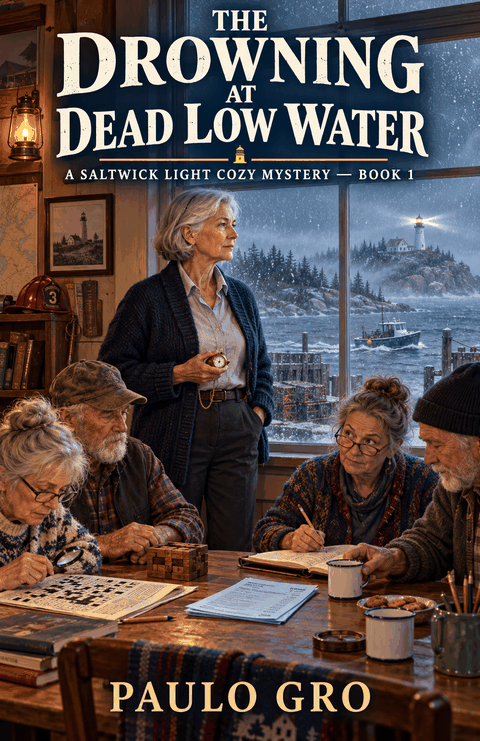
In March 2027, during the week islanders begin baiting traps and arguing over property assessments, Calvin Teague is found in Gullstep Cove after his empty skiff is reported beyond Mercy Head. The official shape is a lone lobsterman lost in a squall; Nell’s reconstruction shows that the ebb and wind shadow could not have carried him into the cove, and salt-drying bands on his oilskins prove he lay ashore after the alleged capsize. Mavis Crowe, the co-op bookkeeper, sedated Calvin’s coffee with stolen clinic medication, struck him with a brass fuel gauge when he confronted her over the storm fund, then used the skiff to stage a drowning; her altered fuel entries, the dry inner coil of Calvin’s pot warp, and an impossible radio timestamp corroborate Nell’s current evidence. Mavis’s motive began with care bills and hardened into concealment. Club friendship, Nell–Miriam conflict, and town regard move: the five neighbors cooperate while refusing the name “detectives,” Miriam threatens to arrange a home assessment after Nell crosses slick ledges, and Owen publicly calls the current calculation useful only after Harper validates it. Calvin’s Gannet Reach LLC offer and Caleb’s matching note open the series thread. Nell pays with two days unable to manage her stairs and with renewed gossip that grief has made her obsessive. The turn comes when Abel demonstrates that the skiff’s cut line never carried Calvin’s weight. Mavis is arrested and the storm fund is restored through sale of her property interest; the closing life hook is an envelope addressed in Caleb’s handwriting, found behind a loose drawer in the club’s puzzle cabinet.
Book 2 — The Cipher in the Chapel Bell
At the June 2027 Blessing of the Fleet, retired surveyor Eamon Sayer rings Saltwick Union Church’s bell out of sequence and is later found dead in the records vestry, poisoned with foxglove concentrate in his customary ginger tonic. Clive Renn, introduced before the festival committee’s midpoint meeting, killed him after Eamon discovered a forged survey pin and backdated access map that would expose Clive’s professional fraud and Saltmere’s tactics. Nell alone times the gaps in Eamon’s last bell sequence and recognizes the grammar of a lighthouse characteristic; plotted as compass bearings, it points to a loose stone holding a 1938 map. Honest clues include tonic residue on Clive’s measuring flask, rain that makes his claimed route impossible without mud, and the mirrored numeral habit in his field notes; red herrings grow from Ada’s hidden church-debt negotiation and Dottie’s bitter family quarrel with Eamon. Romance, club trust, and town regard move: Silas and Nell share the harbor bench after the fleet leaves, Ruth and Abel agree on written evidence rules, and Owen still excludes them from the vestry until their timed reconstruction forces a warrant. The map reveals twelve covenant parcels and “Annex B—rescue lanes” while Clive’s case remains complete on survey fraud and murder. Nell’s bell-tower climb inflames her knees badly enough that she accepts a cane, which she resents for one chapter and then uses. Clive is arrested after Dottie proves his invoice sequence predates his supposed hiring. The life hook is Miriam booking a week on Saltwick without asking whether Nell wants help.
Book 3 — The Knotted Will of Saltwick
During October 2027’s Harvest Knot contest, retired judge Tamsin Lowe is found in her locked net loft beneath a decorative rope display, apparently killed by a structural failure and fall. Her nephew Jonah, on-page as the man repairing the Grange roof by Chapter 4, struck her with a sand-filled sailmaker’s palm after learning she had changed her will, then dressed an unloaded knot and locked the loft using an old sash-weight route. Nell sees that the hitch’s polished lay could not have borne Tamsin’s weight; Abel identifies fresh tool chatter, Ruth recalls a redirected finance letter, and Ivy authenticates the new will’s paper. Red herrings include Tamsin’s threat to expose Roscoe’s old conservation breach and a secret charitable bequest Ada concealed. The Club Forms fully: it adopts consent, custody, and dissent rules after Abel pockets a wood shaving, and Ruth and Abel finally speak about the 1984 registered-mail theft without reconciling neatly. Family and body threads also move as Miriam witnesses Nell’s post-search pain after the delegated loft reconstruction and negotiates transport rather than relocation; the glare around the loft window forces Nell to admit how little her left eye can distinguish, and she schedules cataract surgery instead of postponing it. Probate records disclose identical option language among three Saltmere nominees, advancing the thread without proving coordination. Jonah is arrested when the sash cord fibers and his loan agreement complete the fair chain. The life hook is Owen asking—not ordering—the club to review emergency routes before winter.
Book 4 — Six Minutes in the Whiteout
In February 2028, a blizzard traps residents in the fire-station warming shelter, where Dr. Selma Creel is found dead in the clinic annex after a generator outage, apparently from a cardiac event. Nolan Voss, the mainland medical-supply contractor who arrived on the last ferry and appears by Chapter 3, injected an excessive dose of potassium through an existing IV port after Selma confronted him about diluted emergency drugs, then fabricated a telephone consultation to place himself across the building. Nell correlates generator interruptions with Gull’s Crown’s automatic backup flashes and fixes a six-minute window in which Nolan’s call could not have occurred; Dottie finds mismatched lot totals, Ruth reconstructs the shelter phone tree, and Owen secures the supply locker. Red herrings arise from Selma’s concealed 1999 dispensing error and Lenora’s secret Saltmere-funded generator agreement. Romance and the body clock move when Silas suffers an atrial-fibrillation episode during the storm, Nell holds his hand through transfer, and he later gives up emergency night crossings; institutional trust moves when Owen assigns Nell the bounded task of reconstructing the outage. Saltmere’s private environmental assessment of Gull’s Crown and Miriam’s discovery of Caleb’s collision-data request advance the long thread. Nell pays in snow exposure and public anger for questioning a trusted doctor’s records. Nolan is charged after the backup-flash timeline and diluted vials converge. The hook is a county archivist’s notice that one 1938 storm-relief volume has gone missing.
Book 5 — The Backward Flag at Midsummer
At the August 2028 Saltwick Regatta, maritime curator Lorna Beck is found dead in the locked chart room, smothered off-page and arranged beside an open display case as though she surprised a thief. Antiques dealer Cyrus Bell, present at the opening gala, killed her after she traced his sale of donated signal instruments and their replacement with replicas. Nell notices that a semaphore flag’s faded face is now turned inward and deduces it was reversed to hide a shallow compartment; inside lies Lorna’s substitution ledger and a signal-lamp base bearing Caleb’s copied registry reference. Honest clues include fresh verdigris on Cyrus’s cuff, a replica screw with modern threading, and Dottie’s auction-payment sequence; red herrings include Lorna’s unauthorized artifact rescues and Mae’s private loan to the museum. The Price of Time governs both case and life: Cyrus intends to remove the remaining originals on the evening freight ferry, Ruth struggles to read labels in glare, and Nell falls on museum steps while hurrying, losing mobility for weeks. Family and town regard move as Miriam comes without ultimatums and the harbor youth crew completes the physical search under Abel’s direction. Ivy traces Caleb’s number to the missing county volume. Cyrus is arrested before departure when the lamp base and sales photographs prove substitution and his timeline collapses. The hook is Silas quietly placing an emergency key to his apartment on Nell’s table, which she does not yet take.
Book 6 — A Foghorn Before Christmas
In December 2028, insurance appraiser Hal Merritt is found dead in the ferry freight office after the boat-parade rehearsal, killed by a heavy dose of his own sedative in hot cider and suffocation staged as a drunken collapse. Marian Sayer, Dottie’s younger sister and owner of the marine-fuel business, killed him because Hal had engineered her inflated 2015 fire claim and was blackmailing her for control of the company. Nell hears a voice recording in which ferry-engine cadence and the Mercy Head foghorn echo place Hal in the freight shed rather than aboard Northwind; Silas’s manifest knowledge and Dottie’s recognition of Marian’s rounded sevens complete the route. Repeated listening in the cold freight office leaves Nell unable to separate tones for the rest of the evening, and her public accusation before the recording is cleaned makes Owen question her restraint. Red herrings include Hal’s altered appraisal for Saltmere and Roscoe’s unreported fuel spill. The case shakes the club because Dottie withholds a ledger page to protect Marian, while Silas finally admits he was meant to meet Caleb and chose a repair first. Nell sends both away from the table, then must decide whether rules mean punishment or repair. Family moves when Miriam stays through Christmas and names how Caleb’s public usefulness eclipsed home; romance moves when Nell tells Silas his lateness was a failure but not the cause of Caleb’s choices, and admits she wants him to return after trust is rebuilt. The freight ledger ties Pierce to removal of a damaged Wescott launch in 2018. Marian is arrested after the sound timeline, handwriting, and cider thermos establish guilt; Dottie turns over the withheld page and accepts censure. The hook is Caleb’s last phrase, “Four, then one dark,” now written in Nell’s current log.
Book 7 — The Missing Piece at Breaker House
In May 2029, true-crime producer Felicity Ward comes to Saltwick promising a respectful episode about Caleb and is found dead below Breaker House’s west path after a podcast reception. Chef Graham Noyes, a former rescue swimmer introduced serving the opening supper, sedated her with an antihistamine to retrieve a stolen interview file, then deliberately shoved her during the off-page confrontation at the safer east cove and moved her by garden cart when panic followed intent. Nell identifies east-cove bladderwrack and the falling-tide wet line on Felicity’s coat, proving the body was relocated; because the cove descent exceeds her safe range, she must entrust the decisive sample location to Owen and endure public claims that her earlier quarrel has colored the inference. Abel reads cart repairs, Ruth reconstructs mailed recording copies, and Owen lawfully obtains the audio. Red herrings arise from Nell’s public quarrel with Felicity, Tressa’s effort to buy the archive, and Pierce’s attempt to suppress an Alden interview. The New Routine brings formal cooperation: Owen gives the club a written evidence question, teenagers help map public paths, and the town must confront the difference between valuing elder testimony and consuming it. Romance moves with Nell and Silas’s first kiss after a quiet supper, deliberately separate from danger and followed by an awkward, honest conversation about no one moving house. The compromised Alden recording—“The boy should have yielded”—points toward a visitor log and mechanic but cannot by itself prove the cold matter. Graham is arrested when the wrack, cart fiber, and his falsified rescue account establish motive and movement. The hook is a letter from Bee Lunt asking Nell to witness “a correction overdue since the year the light changed hands.”
Book 8 — The Harvest Lantern Acrostic
At the October 2029 harvest supper, retired clerk Bee Lunt plans to read an acrostic naming where she stored corrected civic records, but she is found dead in her cottage after neighbors saw her silhouette pass a lantern-lit curtain. Her nephew and financial manager Reeve, present while delivering restaurant pies in Chapter 2, killed her with an overdose of prescribed sleep medicine after she arranged to revoke his authority and report his theft; he rigged a clockwork puzzle shutter behind the lantern to create a later moving silhouette. Nell reads wick char, remaining oil, and the too-perfect flash interval and knows the light was a machine imitating a person; the long low-light watch aggravates halos in her treated eye, and Ruth must correct a number Nell cannot safely read, making the method visibly collective. Honest clues include flour absent from Reeve’s supposedly fresh pie boxes, a bank appointment card, and Abel’s recognition of one of his copied cams; red herrings include Bee’s civic confession, Ada’s protected pastoral meeting, and Lenora’s removed executive-session pages. The Autumn Confession is split: Bee’s personal correction solves motive, while her preserved rubbing and letter reveal Alden ordered removal of Annex B in 1978. Lenora releases grant minutes, advancing the thread. Romance, family, and body move as Nell and Silas exchange emergency keys and negotiate separate homes; Nell signs a health proxy with Miriam; Ruth admits she can no longer read standard print and the club changes its materials without ceremony. Reeve is charged after the lantern reconstruction and bank record prove the false time of death. The hook is Alden Wescott’s request to meet Nell alone at Gull’s Crown on the anniversary of automation.
Book 9 — The Last Signal from Gull’s Crown
In March 2030, during the Thirtieth Annual Centennial Relighting—a heritage week founded for Gull’s Crown’s 2000 centennial—Alden Wescott arrives intending to surrender the original covenant annex and record the truth about Caleb, but is found dead at the foot of the interior service stair after a brief false malfunction. Pierce, present as the event’s principal donor before Chapter 3, killed his father during an argument, moved him one landing, and staged an accidental fall while operating the maintenance bypass to call Nell away. Nell recognizes the four flashes followed by one forced dark interval as Caleb’s private home signal, yet the electronic log proves the interruption was made inside the tower; Abel matches hidden launch hardware to Caleb’s skiff fragment, Ivy and Harper recover the certified annex, and Owen assembles the chain without surrendering procedure. Red herrings include Alden’s heart failure, Lenora’s unauthorized key, and Silas’s private visit to beg Alden to confess. All five serial arcs land: Owen brings the timeline to the Thursday table, Abel directs rather than climbs, Ruth uses audio documents, Dottie manages breaks openly, Miriam joins Nell under agreed safety rules, and Silas waits for invitation rather than rescuing. Nell pays by accepting that she cannot make the final tower climb alone and by hearing a truth that removes uncertainty without restoring Caleb. Pierce’s present murder is solved through bypass access, transfer fibers, the signal error, and Alden’s saved draft; he is charged, while the recovered launch and records establish Alden’s responsibility and Pierce’s historical concealment. The Shore Covenant is enforced, Saltwick forms a resident trust, and Saltmere’s consolidation ends. Nell and Silas choose shared seasons with separate homes. The final life hook is not a crime: at the first Thursday meeting in the accessible archive room, a schoolchild delivers a tide riddle and asks whether old questions are allowed. Nell makes room at the table.
Tone and Prose
The narrative voice stands where Nell stands: underestimated, patient, and in possession of sixty years of receipts. It is warm without varnish, dry without contempt, watchful enough to notice that grief and grocery lists occupy the same pocket. Humor comes from character—Ruth’s bureaucratic precision, Abel’s war with instructions, Dottie’s intolerance for rounded numbers, Nell’s refusal to call drizzle weather—and never from age as spectacle. Mortality remains in the room like the tick of a cooling stove: audible, ordinary, and a reason to attend, not a command to despair.
Sentences may lengthen through memory, manual work, meals, weather, and the social routes by which an island learns a fact; when Nell catches the lie, the prose contracts. The tide was wrong. The kettle had not boiled. He could not have heard that bell. Kitchens carry yeast, wet wool, onion skins, scorched coffee, and the metallic taste of worry; church halls carry floor wax, hymnals, steam heat, and old arrangements of power; porches, clinic rooms, boat sheds, ferry decks, and the lighthouse are rendered through all five senses, especially pressure, temperature, balance, vibration, and the shapes sound takes in fog. Hope lives in competent hands and repeated meals rather than speeches. There is no gore, nihilism, coy cruelty, cute senility, magical cure, or sentimental claim that age makes every wound wise.
Pacing Calibration
Saga Trope
- Trope: Retirement-community puzzle-club ensemble led by a reluctant widowed expert.
Narrative Texture Weights
- Quiet contemplative — 32%: The keeper’s method depends on waiting, sensory reconstruction, accumulated memory, and the moral hesitation before an old fact is used against a neighbor.
- Warm rising ensemble — 43%: Five strong histories around one table provide the saga’s primary warmth, friction, humor, clue synthesis, and earned sense of chosen family.
- Emotional and investigative peaks — 25%: Confrontations, peril, discoveries, and solutions must land hard but remain proportionate to a cozy world where aftermath and relationship matter more than spectacle.
- Dialogue balance across each book: Approximately 45% dialogue and 55% narration, varied by scene rather than mechanically enforced paragraph by paragraph.
Anti-Generic Mandate
- No case may be transplanted unchanged to an interchangeable village. Its means, motive, access, and breaking clue must depend on Saltwick’s tides, ferry, working waterfront, church economy, land pressure, family routes, or lightkeeping systems.
- Nell never solves a case by generic intuition. She logs, compares, walks or delegates the route, identifies the broken pattern, admits the method’s limit, and obtains corroboration.
- Every club member’s contribution must arise from a former working life and carry an ethical history, not a decorative quirk.
- The island contains generosity, exclusion, class pressure, queer households, religious obligation, mainland dependence, and disagreement within generations. “The island” never speaks with one mind.
- Old age is inhabited from within: planning around light, stairs, medication, recovery time, pride, grief, desire, usefulness, and the politics of receiving help.
- Each contemporary case differs in victim role, mechanism, motive, setting, clue system, and community consequence.
- The solution may surprise, but no late twin, secret tunnel without prior planting, unknown poison, supernatural intervention, or off-page culprit is permitted.
Canon Change Control
- Any requested change to a fixed fact must be propagated deliberately to this Vault, Case_Ledger.md, every affected Book_X_Canon_Summary.md, and any unassembled outline.
- Completed prose is not silently rewritten by later plans. A genuine conflict is reported before generation continues.
- New named characters must be entered in the Ledger cast register before or at first canonical use.
- [AUTHOR NAME] remains literal on covers and manuscripts until the user supplies the publishing name; once supplied, update this field before producing any cover prompt or manuscript.
Look at what one paste produced: a named saga, “The Thursday Signals of Saltwick Light”; a sleuth who kept Gull’s Crown Light for thirty-eight years; four club members whose former careers — postmaster, boatbuilder, school bookkeeper, ferry captain — are each a working method of detection; and all nine victims and all nine culprits cast before a single chapter exists.
Read the Lived-Experience Detection section. The keeper’s method is written as seven rules — “Log before interpretation,” “Read absence as carefully as presence,” “Pass custody to authority” — with strengths, blind spots, and costs: “Rock ledges and lighthouse stairs inflame her knees; a correct route reconstruction can cost her the following day.” That is a detective system, not a personality quirk.
Then look at the Beat Placement Decisions. The engine is required to reorder its nine emotional beats to fit the trope — here it merges The Town’s Cracks with The First Body in Book 1 and delays The Club Forms to Book 3 — because copying the beats in order is defined as a failure.
And the fair-play law is on the page as law: “Confessions may confirm but never create the solution.” “No book ends with its murder unresolved.” Every chapter of every book is generated under those sentences.
The Case Ledger, Unedited: Ages by Book, Every Grudge on Record, and Nine Arrests Already Scheduled
This is the second file the same paste wrote — the permanent memory of the series. Read it and you will understand why Book 8 cannot forget what Book 2 established.
The Thursday Signals of Saltwick Light — Case Ledger
Ledger Charter
- Purpose: Permanent state record for this saga and every later story set on Saltwick Island.
- Read order before generation: Saga_Canon_Vault.md, this Ledger, every existing Book_X_Canon_Summary.md, then the active book’s outline.md and completed chapters.
- Update point: Immediately after both manuscripts for a book are assembled and its canon summary is written.
- Spoiler warning: This production ledger names victims, culprits, motives, evidence, and the full serial resolution.
- Authority rule: Planned entries are marked PLANNED until the corresponding book is assembled. At Canon Lock they become CANON, amended only to reflect the completed prose without contradicting earlier canon.
- Later-series rule: A sequel or companion series must read this Ledger first, preserve every settled fact, add new registers beneath the existing ones, and never recycle a closed case as an open crime.
Cast Register
Elinor “Nell” Venn
- Born / age at opening: January 8, 1953 / 74.
- Former career: Keeper and head keeper of Gull’s Crown Light; volunteer storm-radio watch.
- Household: Alone at Lantern House with Wick, her elderly ginger cat.
- Health and mobility: Bilateral knee osteoarthritis; early left cataract; fatigue blurs tones. Cane outdoors after Book 2; folding seat after Book 5; cannot make the final tower climb alone in Book 9.
- Town mesh: Venn by birth, widow of Caleb; mother of Miriam, grandmother of Ivy. Respected by older mariners, discounted by automated-era officials, scrutinized by families who remember her emergency decisions. Reluctant chair of the Thursday Puzzle Club.
- Grudges and obligations: Distrusts the Wescotts; resents Silas’s secrecy; opposes Lenora’s closed procedures; feels responsible for every unanswered call made during her watch.
- Current state: PLANNED, Book 1 opening. Widowed, independent, socially peripheral, still keeping private dawn logs.
Ruth Trafton
- Born / age at opening: November 2, 1947 / 79.
- Former career: Saltwick postmaster; mainland mail sorter.
- Household: Shares a duplex with her sister Pearl Trafton.
- Health and mobility: Early right-field macular degeneration; uses magnifiers and strong light; does not drive after dusk. Adopts audio and large-print puzzle material in Book 8.
- Town mesh: Union Church choir alto, unofficial address historian, Trafton cousin to Owen’s mother. Knows kinship, forwarding orders, and official-mail patterns.
- Grudges and obligations: Reported Abel’s brother for registered-mail theft in 1984; refuses to apologize for reporting but regrets the damage around it.
- Current state: PLANNED. Club member who believes sealed mail and private business deserve unusually strong boundaries.
Pearl Trafton
- Born / age at opening: March 16, 1950 / 76.
- Former career: Telephone exchange operator, then school cafeteria manager.
- Household: Shares the Trafton duplex with Ruth.
- Health and mobility: Uses an inhaler for COPD; manages household stairs slowly.
- Town mesh: Church-meal volunteer and former keeper of the storm phone tree. Hears more than she repeats and declines formal club membership.
- Grudges and obligations: Believes Ruth’s civic righteousness often leaves Pearl to manage the personal aftermath.
- Current state: PLANNED recurring household character.
Abel Rusk
- Born / age at opening: July 19, 1944 / 82.
- Former career: Wooden-boat builder; trap, spar, and hull repairer; mechanical-puzzle maker.
- Household: Lives over closed Rusk Boatworks with Sounder, an aging Labrador.
- Health and mobility: Severe hand arthritis; two fused fingers; one hearing aid; slow stairs; cannot kneel without assistance. Directs younger hands increasingly after Book 5.
- Town mesh: Last master of a respected boatbuilding line; mentor to many middle-generation fishermen; estranged from Ruth over his brother’s conviction.
- Grudges and obligations: Blames Ruth for public handling of the 1984 mail theft; hides guilt about a 1976 repair shortcut that injured Silas’s father.
- Current state: PLANNED. Brings the battered wooden brainteasers to Thursday meetings but insists he attends only to keep them from being broken.
Dorothea “Dottie” Sayer
- Born / age at opening: May 30, 1955 / 71.
- Former career: School secretary and bookkeeper; treasurer for island organizations.
- Household: Lives with wife Mae Bell Sayer behind the Grange hall.
- Health and mobility: Controlled type 2 diabetes; foot neuropathy apparent in Book 5; stamina depends on meals and medication.
- Town mesh: Connects school families, supper committees, municipal accounts, Bell kin, and Sayer marine businesses.
- Grudges and obligations: Carries blame for the 2002 high-school closure; protective of younger sister Marian until that loyalty breaches club rules in Book 6.
- Current state: PLANNED. Quietly keeps duplicate attendance and expense books because institutions forget what they owe.
Mae Bell Sayer
- Born / age at opening: February 15, 1954 / 73.
- Former career: Baker and owner of Bell’s Morning Counter; still opens three mornings weekly.
- Household: Lives with Dottie; together since 1983, married in 2014.
- Health and mobility: Breast-cancer survivor; annual October scans; otherwise strong and active.
- Town mesh: Bell cousin network, breakfast trade, church kitchen, caregivers, ferry crew. Moral auditor and provider of the club’s rotating food.
- Grudges and obligations: Resents anyone treating Dottie’s competence as limitless; distrusts Cyrus Bell’s cultivated family pride.
- Current state: PLANNED. Not a regular investigator and not a sixth club detective.
Silas Muir
- Born / age at opening: September 11, 1950 / 76.
- Former career: Captain of packet ferry Northwind; Coast Guard auxiliary coxswain; relief captain through Book 4.
- Household: Widower living above the former chandlery; adult son and family in Rockland.
- Health and mobility: Controlled atrial fibrillation; anticoagulants magnify fall risk. Gives up emergency night crossings after Book 4.
- Town mesh: Knows ferry crew, manifests, mainland docks, rescue volunteers, and the unrecorded favors that move freight.
- Grudges and obligations: Hid his planned 2018 meeting with Caleb because he arrived late; owes Nell truth, not protection. Abel’s old repair error injured Silas’s father.
- Current state: PLANNED. Longtime neighbor, club member, and late-life romantic possibility.
Miriam Venn Bell
- Born / age at opening: August 26, 1975 / 51.
- Career: Regional public-health preparedness coordinator in Portland.
- Household: Divorced; lives alone in Portland; mother of Ivy.
- Health and mobility: Healthy; stress migraines.
- Town mesh: Venn and Bell family ties but mainland residence; valued during emergencies, regarded by some as a daughter who left and returned with forms.
- Grudges and obligations: Childhood shaped by parents whose public duties displaced family time. Tries to manage Nell because logistics are her practiced language of care.
- Current state: PLANNED. Wants Nell to move to Portland and believes Caleb’s case keeps her mother unsafe.
Ivy Bell
- Born / age at opening: June 4, 2001 / 25.
- Career: Graduate student in archival conservation; part-time Saltwick records contract from Book 5.
- Household: Shared Portland apartment; later splits time with Saltwick.
- Health and mobility: No limiting condition established.
- Town mesh: Granddaughter of Nell and Caleb; connected to younger island descendants without being fully local in their eyes.
- Grudges and obligations: Refuses to carry messages between Miriam and Nell; insists family artifacts receive the same provenance discipline as public archives.
- Current state: PLANNED. Affectionate but wary of inherited silence.
Constable Owen Pike
- Born / age at opening: December 18, 1992 / 34.
- Career: Saltwick constable and emergency-management director; former county sheriff’s deputy.
- Household: Lives with husband Theo Pike; foster-parent application becomes placement in Book 8.
- Health and mobility: No limiting condition established.
- Town mesh: Pike father, Trafton mother; official caught among co-op, board, church, state police, and kin expectations.
- Grudges and obligations: Resists inherited elder authority and unofficial evidence handling; must nevertheless protect an under-resourced island.
- Current state: PLANNED. Dismisses Nell’s investigation in Book 1; depends on the club’s timeline testing in Book 9.
Theo Pike
- Born / age at opening: May 21, 1991 / 35.
- Career: Mainland paramedic.
- Household: With Owen; commutes by ferry; foster parent from Book 8.
- Health and mobility: No limiting condition established.
- Town mesh: Trusted in medical emergencies but still called “Owen’s mainland husband” by elders who have known him ten years.
- Grudges and obligations: Supports Owen while objecting to work becoming the only room in their marriage.
- Current state: PLANNED recurring family character.
Caleb Venn
- Born / age at disappearance: February 20, 1950 / 68 on October 18, 2018.
- Former career: Marine surveyor, volunteer light technician, and boat-safety instructor.
- Household at disappearance: Lantern House with Nell.
- Health and mobility at disappearance: Fit, mild untreated hypertension.
- Town mesh: Useful across fishing families and municipal projects; privately absent in ways Miriam still resents.
- Grudges and obligations: Challenged Alden Wescott over the Shore Covenant; expected Silas to witness a document exchange.
- Current state: ESTABLISHED DEAD / body unrecovered. Officially lost by misadventure at saga opening; Book 9 establishes Alden rammed his skiff and failed to render aid, with Pierce concealing evidence.
Wick
- Age at opening: Approximately 15.
- Role / household: Nell’s ginger cat at Lantern House.
- Health and mobility: Elderly, sleeps near heat, dislikes the carrier.
- Town mesh: None; never discovers clues or supplies comic “testimony.”
- Current state: PLANNED alive at Book 1 opening. Any death or illness must be entered before use.
Sounder
- Age at opening: Approximately 12.
- Role / household: Abel’s black Labrador at Rusk Boatworks.
- Health and mobility: Stiff hips.
- Town mesh: Familiar at the yard; never used as a supernatural detector.
- Current state: PLANNED alive at Book 1 opening.
Pierce Wescott
- Born / age at opening: March 2, 1979 / 48.
- Career: Principal of Saltmere Holdings; former hotel-finance executive.
- Household: Divorced; mainland home; Tideglass House on Saltwick from Book 3.
- Health and mobility: No limiting condition established.
- Town mesh: Donor to ferry, clinic, museum, and fire-station projects; employer of mainland consultants; son of Alden. Courted by tax-burdened owners and opposed by working-waterfront families.
- Grudges and obligations: Believes Saltwick humiliated Alden’s resort ambitions and mistakes acquisition for stewardship. Concealed the launch and Caleb’s tube in 2018.
- Current state: PLANNED recurring antagonist; Book 9 culprit. Arrested at Book 9 close.
Alden Wescott
- Born / age at opening: December 3, 1944 / 82.
- Former career: Real-estate attorney and former Saltwick select-board counsel.
- Household: Assisted-living apartment in Camden.
- Health and mobility: Congestive heart failure; physically frail, cognitively lucid.
- Town mesh: Old legal architect of mainland development schemes; father of Pierce; feared by elders who signed papers through him.
- Grudges and obligations: Removed the local Covenant annex in 1978; rammed Caleb’s skiff in 2018 and left without aid; wants confession late without surrendering control of its terms.
- Current state: PLANNED alive through Book 8; Book 9 victim.
Lenora Dyer
- Born / age at opening: February 9, 1968 / 59.
- Career: Dyer Hardware owner; chair of Saltwick’s select board.
- Household: With husband Frank Dyer.
- Health and mobility: No limiting condition established.
- Town mesh: Middle-generation civic broker linking taxes, ferry funding, supplies, fire volunteers, and property owners.
- Grudges and obligations: Accepts restricted Saltmere grants to keep services alive; hides negotiations to prevent both political factions from destroying partial deals.
- Current state: PLANNED. Compromised but not corrupt; releases executive-session records in Book 8.
Frank Dyer
- Born / age at opening: September 7, 1965 / 61.
- Former career: Electrician; semi-retired.
- Household: With Lenora above Dyer Hardware.
- Health and mobility: Shoulder replacement limits overhead work.
- Town mesh: Volunteer fire engineer, practical intermediary between Abel’s generation and current tradespeople.
- Grudges and obligations: Dislikes Saltmere but sees how often Lenora is left to fund services with sentiment.
- Current state: PLANNED recurring background character.
Roscoe Kittredge
- Born / age at opening: January 27, 1970 / 57.
- Career: Lobsterman; president of Saltwick Fishermen’s Cooperative.
- Household: Multigenerational Kittredge Point household; spouse remains unnamed until registered.
- Health and mobility: Old rotator-cuff injury; otherwise working strength.
- Town mesh: Controls access to co-op labor and informal working-waterfront consensus.
- Grudges and obligations: Protects an old conservation violation and family dominance; opposes Saltmere’s access consolidation.
- Current state: PLANNED recurring suspect, blocker, and ally; never a culprit in the nine-book saga.
Reverend Ada Lunt
- Born / age at opening: June 12, 1963 / 63.
- Career: Pastor of Saltwick Union Church.
- Household: Alone in parsonage; two unnamed adult sons off-island.
- Health and mobility: No limiting condition established.
- Town mesh: Holds funeral, food, pastoral, and church-property networks. Niece of Bee Lunt.
- Grudges and obligations: Must protect confidences while stopping preventable harm; secretly negotiates to prevent sale of the shore meadow.
- Current state: PLANNED recurring ethical counterweight.
Detective Harper Nadeau
- Born / age at opening: October 6, 1985 / 41.
- Career: Maine State Police major-crimes detective.
- Household: Mainland spouse and one teenage child, both unnamed until registered.
- Health and mobility: No limiting condition established.
- Town mesh: Formal outside authority; neither captured by island loyalties nor immune to mainland assumptions.
- Grudges and obligations: Protects chain of custody; distrusts premature publicity; values reproducible specialist knowledge.
- Current state: PLANNED. Moves from wary tolerance to treating Nell as a maritime-pattern consultant.
Tressa March
- Born / age at opening: February 14, 1983 / 44.
- Career: Owner-editor of the weekly Penobscot Beacon.
- Household: Mainland home; occasional overnight room above Saltwick print office.
- Health and mobility: No limiting condition established.
- Town mesh: Connects public notices, court reporting, mainland corporate searches, and island whistleblowers.
- Grudges and obligations: Wants Saltmere exposed, must keep her failing paper alive, and sometimes publishes before relationships are ready.
- Current state: PLANNED recurring investigator-adjacent character.
Calvin Teague
- Age at death: 56 in Book 1.
- Career: Lobsterman; co-op storm-fund auditor.
- Household: Separated; adult child unnamed until registered.
- Health and mobility: Strong working health; no condition material to death.
- Town mesh: Teague fishing line, co-op numbers, emergency generosity, abrasive audits.
- Grudges and obligations: Confronted Mavis over theft; considering Gannet Reach offer for bait shed.
- Current state: PLANNED Book 1 victim.
Mavis Crowe
- Age at opening: 61.
- Career: Co-op bookkeeper; volunteer fuel coordinator.
- Household: Alone after mother’s death; household heavily mortgaged.
- Health and mobility: No limiting condition established.
- Town mesh: Trusted with storm accounts and fuel priority; Crowe family once owned shore acreage.
- Grudges and obligations: Began stealing for care bills, continued to conceal the theft, and killed Calvin when discovery became certain.
- Current state: PLANNED Book 1 culprit; arrested and removed from free community life.
Eamon Sayer
- Age at death: 68 in Book 2.
- Former career: Surveyor; church bell ringer.
- Household: Widower living in a converted schoolhouse.
- Health and mobility: Mild essential tremor; ambulatory.
- Town mesh: Sayer cousin to Dottie and Marian; boundary knowledge; church routine.
- Grudges and obligations: Resented Dottie over school closure; opposed falsified Saltmere access maps.
- Current state: PLANNED Book 2 victim.
Clive Renn
- Age in Book 2: 44.
- Career: Licensed surveyor; Saltmere acquisitions consultant posing as heritage adviser.
- Household: Mainland; details immaterial unless later registered.
- Health and mobility: No limiting condition established.
- Town mesh: Newcomer moving through select-board, church-property, and buyer networks.
- Grudges and obligations: Forged a pin and backdated maps; killed Eamon to protect license and scheme.
- Current state: PLANNED Book 2 culprit; arrested.
Tamsin Lowe
- Age at death: 83 in Book 3.
- Former career: Probate judge.
- Household: Alone in Lowe House; nephew Jonah expected to inherit.
- Health and mobility: Uses a cane; independent on familiar stairs.
- Town mesh: Elder legal authority, Harvest Knot judge, owner of disputed shore lane.
- Grudges and obligations: Intended to transfer lane to public trust; threatened Roscoe over conservation history.
- Current state: PLANNED Book 3 victim.
Jonah Lowe
- Age in Book 3: 42.
- Career: Seasonal roofing contractor.
- Household: Mainland rental; separated partner unnamed.
- Health and mobility: No limiting condition established.
- Town mesh: Local heir who left, returns for contracts and expected property.
- Grudges and obligations: Borrowed against expected inheritance; killed Tamsin when her new will meant ruin.
- Current state: PLANNED Book 3 culprit; arrested.
Dr. Selma Creel
- Age at death: 61 in Book 4.
- Career: Island physician; emergency coordinator.
- Household: Alone above clinic.
- Health and mobility: No limiting condition established.
- Town mesh: Medical confidante and gatekeeper across all generations.
- Grudges and obligations: Concealed an old dispensing error; discovered Nolan’s present emergency-drug dilution.
- Current state: PLANNED Book 4 victim.
Nolan Voss
- Age in Book 4: 55.
- Career: Medical-supply contractor; former pharmacist.
- Household: Mainland; details immaterial unless registered later.
- Health and mobility: No limiting condition established.
- Town mesh: Outsider with long vendor access to clinic and emergency shelter.
- Grudges and obligations: Diluted emergency drugs for resale profit; killed Selma to prevent reporting.
- Current state: PLANNED Book 4 culprit; arrested.
Lorna Beck
- Age at death: 47 in Book 5.
- Career: Curator of Saltwick Maritime Rooms.
- Household: Rents museum keeper’s apartment; no partner established.
- Health and mobility: No limiting condition established.
- Town mesh: Newer preservation professional reliant on elder donations and summer donors.
- Grudges and obligations: Secretly rescued artifacts without clean title; discovered Cyrus’s substitution sales.
- Current state: PLANNED Book 5 victim.
Cyrus Bell
- Age in Book 5: 66.
- Career: Maritime antiques dealer.
- Household: Mainland; widower.
- Health and mobility: Mild gout; ambulatory.
- Town mesh: Distant Bell cousin; donor-class access to museum and auctions.
- Grudges and obligations: Sold donated instruments, installed replicas, and killed Lorna when she documented the scheme.
- Current state: PLANNED Book 5 culprit; arrested.
Hal Merritt
- Age at death: 64 in Book 6.
- Career: Insurance appraiser.
- Household: Mainland; divorced.
- Health and mobility: Prescribed sedative for insomnia; otherwise mobile.
- Town mesh: Vendor to ferry, wharf, fuel, and Saltmere interests; keeper of compromised claims.
- Grudges and obligations: Blackmailed Marian over the 2015 fuel-shed fire claim.
- Current state: PLANNED Book 6 victim.
Marian Sayer
- Age in Book 6: 58.
- Career: Owner of Sayer Marine Fuel.
- Household: Alone; Dottie’s younger sister.
- Health and mobility: Chronic wrist tendinitis; otherwise working health.
- Town mesh: Essential fuel supplier, Sayer family, co-op and ferry accounts.
- Grudges and obligations: Hid an inflated fire claim, yielded to years of blackmail, then killed Hal rather than lose the business.
- Current state: PLANNED Book 6 culprit; arrested.
Felicity Ward
- Age at death: 38 in Book 7.
- Career: Producer-host of Vanished Coast.
- Household: Mainland; personal details withheld unless later registered.
- Health and mobility: No limiting condition established.
- Town mesh: Visiting media figure welcomed by businesses, distrusted by families, courted by Tressa and Pierce for different reasons.
- Grudges and obligations: Secretly sold unpublished interviews and threatened Graham with exposure.
- Current state: PLANNED Book 7 victim.
Graham Noyes
- Age in Book 7: 46.
- Career: Breaker House chef; former Coast Guard rescue swimmer.
- Household: Divorced; child unnamed, custody settlement central to motive but not exploited on-page.
- Health and mobility: Old ankle injury; otherwise capable.
- Town mesh: Respected newcomer whose rescue reputation granted rapid belonging.
- Grudges and obligations: Falsified a heroic rescue account; killed Felicity during an attempt to reclaim her evidence.
- Current state: PLANNED Book 7 culprit; arrested.
Beatrice “Bee” Lunt
- Age at death: 81 in Book 8.
- Former career: Saltwick town clerk.
- Household: Alone in Lunt Cottage; Reeve manages finances.
- Health and mobility: Uses a walker outdoors; sound cognition; prescribed sleep medicine.
- Town mesh: Aunt to Ada, elder records authority, harvest acrostic keeper, witness to 1978 civic concealment.
- Grudges and obligations: Preparing to expose Reeve’s theft and confess her compliance with Alden’s annex removal.
- Current state: PLANNED Book 8 victim.
Reeve Lunt
- Age in Book 8: 51.
- Career: Mainland restaurant owner; Bee’s financial manager under power of attorney.
- Household: Mainland; spouse not established.
- Health and mobility: No limiting condition established.
- Town mesh: Lunt heir, harvest-supper supplier, occasional church donor.
- Grudges and obligations: Diverted Bee’s funds to failing restaurant; killed her before revocation and report.
- Current state: PLANNED Book 8 culprit; arrested.
Case File
Book 1 — The Drowning at Dead Low Water — PLANNED
- Calendar: March 8–15, 2027; late winter / trap-setting preparations.
- Victim: Calvin Teague, 56, lobsterman and storm-fund auditor.
- Discovery: Found in Gullstep Cove after empty skiff report; apparent drowning.
- Actual method: Sedative placed in coffee, followed by a fatal strike with a brass fuel gauge; body transported by skiff and staged on shore. Violence remains off-page.
- Culprit: Mavis Crowe, 61, co-op bookkeeper.
- Motive: Prevent Calvin exposing withdrawals from the co-op storm fund, initially made for her mother’s care and later enlarged to conceal the first theft.
- Honest clues: Impossible ebb/back-eddy drift; salt-drying bands placing Calvin ashore; dry inner pot-warp coil; altered fuel ledger; impossible radio timestamp.
- Red herrings: Roscoe’s conservation violation; Calvin’s Saltmere offer; family anger over his separation.
- Career-only breaking clue: Nell’s current-and-wind reconstruction proves the official route physically impossible.
- Club corroboration: Abel reads the unloaded line; Dottie finds ledger sequence; Ruth identifies a notice mailed earlier than Mavis admits; Silas tests skiff timing.
- Justice: Arrest and restoration claim against Mavis’s property interest.
- Town lesson: Need can explain a first wrong without making later concealment harmless; emergency funds require shared oversight.
- Series-thread yield: Gannet Reach offer and Caleb’s matching note.
Book 2 — The Cipher in the Chapel Bell — PLANNED
- Calendar: June 17–24, 2027; Blessing of the Fleet.
- Victim: Eamon Sayer, 68, retired surveyor and bell ringer.
- Discovery: In the church records vestry after an irregular bell sequence.
- Actual method: Foxglove concentrate in habitual ginger tonic.
- Culprit: Clive Renn, 44, Saltmere survey consultant.
- Motive: Prevent disclosure of a forged survey pin and backdated access maps that would destroy his license and expose the acquisition strategy.
- Honest clues: Timed bell bearings; residue in measuring flask; mud-free shoes despite claimed route; mirrored numerals in field notes; hidden 1938 map.
- Red herrings: Ada’s church-debt negotiation; Dottie’s feud with Eamon; a disputed graveyard boundary.
- Career-only breaking clue: Nell reads intervals as a lighthouse characteristic rather than counting peals.
- Club corroboration: Dottie decodes invoice chronology; Ruth locates mailing trail; Abel checks the loose-stone mechanism; Silas plots bearings.
- Justice: Arrest, license evidence transferred to state board, forged boundary voided.
- Town lesson: Heritage language can conceal extraction; a record matters only when someone is willing to interpret and defend it.
- Series-thread yield: First direct reference to Annex B and twelve parcels.
Book 3 — The Knotted Will of Saltwick — PLANNED
- Calendar: October 12–19, 2027; Harvest Knot week.
- Victim: Tamsin Lowe, 83, retired probate judge.
- Discovery: Locked net loft beneath a decorative rope display; apparent fall from failed support.
- Actual method: Fatal blow with sand-filled sailmaker’s palm; body placed; loft locked through sash-weight route.
- Culprit: Jonah Lowe, 42, nephew.
- Motive: Tamsin’s new will removed the inheritance against which Jonah had secretly borrowed.
- Honest clues: Unloaded knot lay; fresh sash-channel chatter; redirected finance letter; new-will paper and witness timing.
- Red herrings: Roscoe’s threatened exposure; Ada’s concealed charitable bequest; public-access campaign anger.
- Career-only breaking clue: Nell knows the polished hitch never carried the body’s load.
- Club corroboration: Abel reads tool and fiber evidence; Ruth reconstructs forwarding; Dottie finds the loan schedule; Silas verifies access timing.
- Justice: Arrest; new will admitted after independent authentication.
- Town lesson: Inheritance expectation is not ownership, and elder autonomy does not expire when heirs become impatient.
- Series-thread yield: Three nominee options share distinctive language.
Book 4 — Six Minutes in the Whiteout — PLANNED
- Calendar: February 4–11, 2028; blizzard and warming-shelter week.
- Victim: Dr. Selma Creel, 61, island physician.
- Discovery: Clinic annex during generator outage; apparent cardiac event.
- Actual method: Lethal potassium dose through existing IV port.
- Culprit: Nolan Voss, 55, medical-supply contractor.
- Motive: Selma discovered substitution and dilution of emergency medicines for resale.
- Honest clues: Six-minute generator/light window; impossible consultation call; mismatched lot totals; supply-locker fibers.
- Red herrings: Selma’s old dispensing error; Lenora’s secret generator grant; a patient’s angry threat.
- Career-only breaking clue: Automated backup flashes time the outage independently of clocks inside the shelter.
- Club corroboration: Dottie audits lots; Ruth reconstructs call messages; Abel assesses locker damage; Silas places ferry arrival.
- Justice: Arrest and statewide medical-supply investigation.
- Town lesson: Trust in a caregiver and scrutiny of a system can coexist; emergency scarcity invites both solidarity and exploitation.
- Series-thread yield: Saltmere assessment of Gull’s Crown/Nettle Shoal; Caleb’s collision-data request.
Book 5 — The Backward Flag at Midsummer — PLANNED
- Calendar: August 16–23, 2028; regatta week.
- Victim: Lorna Beck, 47, maritime curator.
- Discovery: Locked chart room beside opened display case.
- Actual method: Smothered off-page during confrontation; staged as interrupted theft.
- Culprit: Cyrus Bell, 66, antiques dealer.
- Motive: Prevent exposure of donated signal instruments sold and replaced with replicas.
- Honest clues: Reversed flag fading; hidden substitution ledger; fresh verdigris; modern screw thread; auction payment sequence.
- Red herrings: Lorna’s titleless artifact rescues; Mae’s private museum loan; a donor’s public quarrel.
- Career-only breaking clue: Nell reads unequal fading as evidence the flag was reversed to hide the compartment.
- Club corroboration: Abel distinguishes replica manufacture; Dottie follows payments; Ruth matches donation letters; Ivy authenticates the registry notation.
- Justice: Arrest before freight departure; artifacts recovered through warrants and buyer cooperation.
- Town lesson: Preservation without provenance can become possession; elders’ donated histories require accountable stewardship.
- Series-thread yield: Caleb’s registry reference in genuine lamp base.
Book 6 — A Foghorn Before Christmas — PLANNED
- Calendar: December 7–14, 2028; boat-parade rehearsal and remembrance season.
- Victim: Hal Merritt, 64, insurance appraiser.
- Discovery: Ferry freight office; staged drunken collapse.
- Actual method: Heavy dose of prescribed sedative in cider, followed by suffocation off-page.
- Culprit: Marian Sayer, 58, marine-fuel owner.
- Motive: End Hal’s blackmail over an inflated 2015 fire claim and prevent loss of her business.
- Honest clues: Foghorn echo and engine cadence in recording; rounded sevens in altered freight entry; thermos trace; ferry manifest impossibility.
- Red herrings: Hal’s Saltmere appraisal; Roscoe’s spill; Silas’s unlogged freight favor.
- Career-only breaking clue: Nell places the recording at the freight shed by foghorn travel and echo.
- Club corroboration: Silas reconstructs engine sequence; Dottie identifies Marian’s figures; Ruth tracks the thermos gift; Abel reads office-door wear.
- Justice: Marian arrested; insurance fraud referred separately; Dottie turns over withheld evidence.
- Town lesson: Family loyalty without truth becomes permission; confession after concealment must include consequence.
- Series-thread yield: Silas’s meeting truth; Caleb’s phrase; ledger showing Pierce moved damaged launch.
Book 7 — The Missing Piece at Breaker House — PLANNED
- Calendar: May 9–16, 2029; spring reopening.
- Victim: Felicity Ward, 38, true-crime producer.
- Discovery: Below Breaker House west path after reception.
- Actual method: Sedated with antihistamine; deliberately shoved to a fatal off-page fall at east cove; body moved by garden cart.
- Culprit: Graham Noyes, 46, chef and former rescue swimmer.
- Motive: Recover proof that his celebrated rescue account was falsified and protect career and custody standing.
- Honest clues: East-cove bladderwrack; falling-tide wet line; cart fiber and repaired wheel; copied recording-mail trail.
- Red herrings: Nell’s argument with victim; Tressa’s archive bid; Pierce’s suppression attempt.
- Career-only breaking clue: Nell identifies shore and tide contact from wrack ecology and wetting height.
- Club corroboration: Abel reads cart repair; Ruth traces packages; Dottie follows archive payment; Silas tests cove route.
- Justice: Arrest after audio warrant and physical route proof.
- Town lesson: Listening to elders is not the same as owning their pain; public attention requires consent and context.
- Series-thread yield: Compromised Alden interview and path to visitor log/mechanic.
Book 8 — The Harvest Lantern Acrostic — PLANNED
- Calendar: October 10–17, 2029; harvest supper.
- Victim: Beatrice “Bee” Lunt, 81, retired town clerk.
- Discovery: In Lunt Cottage after a lantern silhouette suggests she was alive later.
- Actual method: Overdose of prescribed sleep medicine; clockwork shutter creates false silhouette.
- Culprit: Reeve Lunt, 51, nephew and financial manager.
- Motive: Prevent revocation of authority and disclosure of theft from Bee’s accounts.
- Honest clues: Wick char/oil contradiction; machine-perfect flash interval; empty pie boxes lacking flour; bank appointment; copied Abel cam.
- Red herrings: Bee’s civic confession; Ada’s pastoral meeting; Lenora’s missing minutes.
- Career-only breaking clue: Nell proves the lantern performance outlasted its fuel and lacked human irregularity.
- Club corroboration: Abel recognizes copied mechanism; Dottie audits accounts; Ruth decodes acrostic; Silas times Reeve’s ferry path.
- Justice: Arrest; power of attorney frozen; estate funds traced.
- Town lesson: Frailty cannot be presumed from age, and assistance without accountability can become captivity.
- Series-thread yield: Bee’s confession/rubbing; Alden’s 1978 order; Lenora’s grant minutes.
Book 9 — The Last Signal from Gull’s Crown — PLANNED
- Calendar: March 18–25, 2030; Thirtieth Annual Centennial Relighting, the heritage tradition begun in 2000.
- Victim: Alden Wescott, 85, retired attorney.
- Discovery: Foot of interior service stair during false light malfunction.
- Actual method: Fatal blow with removable brass handrail finial; body moved one landing and staged as fall.
- Culprit: Pierce Wescott, 51, Saltmere principal and Alden’s son.
- Motive: Stop Alden’s confession, preserve the parcel consolidation, and protect the identity and control built on the Wescott project.
- Honest clues: Four-flash/one-dark false signal; interior bypass log; brass residue and missing finial felt; landing-transfer fibers; saved confession draft.
- Red herrings: Alden’s heart failure; Lenora’s unauthorized key; Silas’s private visit.
- Career-only breaking clue: Nell recognizes Caleb’s private home signal but proves it was imposed locally through the maintenance bypass.
- Club corroboration: Abel matches finial and historic launch hardware; Dottie maps nominee financing; Ruth reconstructs certified-mail custody; Silas proves crossing access; Ivy authenticates annex and documents.
- Justice: Pierce charged with Alden’s murder, evidence tampering, obstruction, and historical concealment-related offenses; Alden’s estate exposed to claims; covenant enforced through court.
- Town lesson: A community survives neither by selling every inheritance nor by embalming itself; stewardship requires shared rules, accessible records, and living consent.
- Series-thread yield: Complete resolution of Caleb’s crossing and Saltmere acquisition plan.
Relationship Register
Thursday Puzzle Club — Chosen-Family Arc
- Book 1 — PLANNED: Five neighbors collaborate around Calvin’s timeline but refuse a collective identity. Nell leads by asking for discrete skills. Ruth and Abel speak only through corrections. The envelope found in Abel’s cabinet gives them a reason to meet again.
- Book 2 — PLANNED: They adopt three rules: write the source, separate fact from inference, and hand physical evidence to Owen. Ruth and Abel jointly time the chapel bell without resolving their history.
- Book 3 — PLANNED: The group formally names itself the Thursday Puzzle Club for public purposes. Abel’s pocketing of a shaving triggers a custody dispute; he apologizes. Ruth and Abel state their 1984 positions and agree that remaining at the same table is not the same as absolution.
- Book 4 — PLANNED: The club operates as a distributed team during the shelter crisis. Mae institutes a call-in/call-out rule so no member disappears into a solo search.
- Book 5 — PLANNED: Younger volunteers become the club’s hands after Nell’s fall and Abel’s arthritis. Ruth discloses her visual loss to the whole table. An accessibility fund is proposed.
- Book 6 — PLANNED: Dottie withholds evidence for Marian; Silas reveals his Caleb concealment. Both are suspended from case discussion, then return through full disclosure and agreed consequence. The group learns rules can repair rather than merely expel.
- Book 7 — PLANNED: Owen recognizes the club in writing as community timeline consultants with no enforcement power. The members defend one another against Felicity’s extractive storytelling without pretending all secrets deserve protection.
- Book 8 — PLANNED: Large-print/audio materials and a reliable stair lift become ordinary. Ruth and Abel complete a wooden-and-audio tide puzzle together; neither calls it reconciliation, but both sign it.
- Book 9 — PLANNED: Thursday supper rotation, emergency key protocol, accessibility fund, and archive duties become permanent. The group can quarrel without threatening dissolution.
Nell and Miriam — Family Arc
- Book 1 — PLANNED: Miriam threatens a home assessment after Nell’s ledge search; Nell conceals two days of immobility. Trust worsens despite shared love.
- Book 2 — PLANNED: Miriam books an island week without consent. She sees Nell’s expertise but mistakes assistance for takeover.
- Book 3 — PLANNED: They negotiate a first boundary: Nell accepts rides after strenuous searches; Miriam stops contacting services without discussion. Ivy refuses messenger duty.
- Book 4 — PLANNED: Miriam’s emergency training helps without displacing Nell. She finds Caleb’s collision-data request and shares it before forming a theory.
- Book 5 — PLANNED: Miriam cares for Nell after the fall without raising relocation. Nell gives her the true pain assessment and accepts temporary equipment.
- Book 6 — PLANNED: Miriam names the childhood cost of Caleb and Nell’s public duty. Nell listens without defending the marriage; Christmas is tender but unresolved.
- Book 7 — PLANNED: Nell tells Miriam about the podcast danger before acting. Miriam supports refusal without managing the investigation.
- Book 8 — PLANNED: Nell designates Miriam as health proxy under written limits; Ivy takes archive work by choice. The family discusses Caleb as a flawed father and loved man.
- Book 9 — PLANNED: Miriam abandons the relocation campaign. Nell signs a shared safety plan and promises prospective calls. Ivy becomes custodian of the Shore Trust archive; no one is assigned mediator.
Nell and Ivy — Grandmother/Granddaughter Arc
- Book 1 — PLANNED: Ivy refuses to carry Miriam’s concern as an argument; Nell respects the refusal after initial hurt.
- Book 3 — PLANNED: Ivy authenticates Tamsin’s will paper under professional limits and teaches Nell why provenance matters.
- Book 5 — PLANNED: Ivy begins Saltwick archive contract and finds Caleb’s registry trail without surrendering the document to family possession.
- Book 7 — PLANNED: Ivy helps establish consent terms for family recordings and refuses Felicity’s access.
- Book 8 — PLANNED: Ivy preserves Bee’s rubbing and lets the family hear its implications together.
- Book 9 — PLANNED: Ivy accepts public archive stewardship with independent governance, turning inheritance into service without remaining trapped on the island.
Nell and Silas — Late-Life Romance
- Book 1 — PLANNED: Silas brings coffee and route knowledge; familiarity remains edged by Nell’s suspicion that he knows more about Caleb.
- Book 2 — PLANNED: They share the harbor bench after the Blessing fleet departs. Nell accepts a second cup without calling it company.
- Book 3 — PLANNED: A second mug remains at Lantern House. Silas repairs nothing without asking.
- Book 4 — PLANNED: Nell holds Silas’s hand during his heart episode. He surrenders night-crossing duty; she does not minimize the loss.
- Book 5 — PLANNED: Silas leaves an emergency key; Nell keeps it on the table but does not take it.
- Book 6 — PLANNED: His 2018 concealment breaks trust. Nell distinguishes his failure from responsibility for Caleb and admits she wants a future conversation, not immediate forgiveness.
- Book 7 — PLANNED: After repair through truthful acts, they share a first kiss following a quiet supper. They explicitly reject replacing spouses or merging homes by default.
- Book 8 — PLANNED: They exchange emergency keys, discuss medication, solitude, overnight expectations, and the dead. Relationship is settled in commitment after Book 7, not before.
- Book 9 — PLANNED: They choose alternating suppers, separate homes, shared seasons, and mutual health authority limited by consent. Final image includes Silas making room at the table, not standing as rescuer.
Nell and Owen — Institutional Trust
- Book 1 — PLANNED: Owen orders Nell away and later credits only her calculation, not her role.
- Book 2 — PLANNED: He excludes the club from vestry evidence, then accepts its written timing report.
- Book 3 — PLANNED: Enforces custody after Abel’s mistake; begins sharing public documents proactively.
- Book 4 — PLANNED: Gives Nell a bounded official reconstruction question.
- Book 5 — PLANNED: Uses the club to direct volunteers but confronts Nell for exceeding mobility limits.
- Book 6 — PLANNED: Requires Dottie’s withheld page and refuses family exceptions; the club ultimately supports him.
- Book 7 — PLANNED: Establishes written consultant status and lawful evidence boundaries.
- Book 8 — PLANNED: Asks the club to test the lantern timeline before seeking a warrant.
- Book 9 — PLANNED: Brings the official timeline to the Thursday table before signing it and credits each expert publicly.
Ruth and Abel — Grievance and Repair
- Book 1 — PLANNED: Communicate through corrections; neither trusts the other with interpretation.
- Book 2 — PLANNED: Joint bell reconstruction proves competence can coexist with anger.
- Book 3 — PLANNED: Name the 1984 theft conflict. Ruth will not regret reporting; Abel admits his brother harmed families. No easy embrace.
- Book 5 — PLANNED: Abel builds Ruth a slanted light board; she pays him and refuses the frame as charity.
- Book 6 — PLANNED: Ruth argues for Dottie’s return under rules, showing she has learned consequence need not mean banishment.
- Book 8 — PLANNED: They co-sign a tactile/audio tide puzzle.
- Book 9 — PLANNED: They disagree about archive access, negotiate a workable policy, and remain friends without rewriting 1984.
Series Thread Register
Thread A — The 1938 Saltwick Shore Covenant
- Established: Great Gale rescue and working-access covenant exists; public deed lacks Annex B.
- Suspected at Book 1 opening: Caleb believed a forgotten restriction could block consolidated development.
- Book 1 — PLANNED exposure: Gannet Reach offer shares anomaly with another nominee document.
- Book 2 — PLANNED exposure: Eamon’s map names Annex B and circles twelve parcels.
- Book 3 — PLANNED exposure: Three option contracts repeat distinctive language.
- Book 4 — PLANNED exposure: Saltmere privately assessed light and shoal property.
- Book 5 — PLANNED exposure: Caleb’s registry reference identifies a mis-transcribed volume.
- Book 6 — PLANNED exposure: Freight ledger proves evidence movement by Pierce.
- Book 7 — PLANNED exposure: Alden recording points toward historic confrontation.
- Book 8 — PLANNED exposure: Bee’s confession and rubbing prove local removal; board minutes prove coordinated grant pressure.
- Book 9 — PLANNED settlement: Certified annex recovered, common beneficial ownership proved, compulsory purchase option enforced, Shore Trust formed.
- Still unknown until Book 9: Annex text, document tube location, final legal application.
Thread B — Caleb Venn’s Last Crossing
- Established: Left October 18, 2018; skiff fragment found; official misadventure; no body.
- Suspected at Book 1 opening: Hull damage inconsistent with shoal; meeting concerned shore documents.
- Book 1: “Gannet?” in tide book.
- Book 2: Survey map supplies object of dispute.
- Book 4: Collision-data request proves Caleb anticipated vessel contact.
- Book 5: Registry number shows he found annex trail.
- Book 6: Silas reveals meeting and “Four, then one dark”; ledger ties Pierce to launch removal.
- Book 7: Alden’s compromised “should have yielded” statement.
- Book 8: Proof Alden suppressed annex locally.
- Book 9 settlement: Alden rammed Caleb during confrontation and chose not to render aid; Pierce concealed launch and tube. Physical, documentary, and draft-confession evidence supports official historical finding.
- Emotional remainder: Body unrecovered; Nell receives fact rather than complete farewell.
Thread C — Saltmere’s Parcel Acquisition
- Established: Pierce publicly presents restoration and tax-base plan; nominee LLCs make offers.
- Suspected: Common financing and resort-scale control.
- Book 1: Gannet Reach identified.
- Book 2: Boundary manipulation documented.
- Book 3: Common option language.
- Book 4: Private assessment outside public project description.
- Book 5: Artifact sponsorship used for reputation and access, though not the murder motive.
- Book 6: Hal appraisal shows contingent wharf valuation; separate from Marian’s case motive.
- Book 7: Pierce attempts media suppression.
- Book 8: Grant minutes reveal conditions; Lenora’s compromises made public.
- Book 9 settlement: Beneficial ownership map completed; purchases voidable; plan collapses; lawful resident trust takes options.
Thread D — The Bellwether Box
- Established: Caleb commissioned a battered wooden interlocking puzzle from Abel in 2018; it stayed in the fire-station cabinet.
- Book 1: Hidden drawer releases Caleb-addressed envelope containing only an obsolete registry abbreviation and four punched dots with one gap.
- Book 2: Bell bearings reveal the dots are a signal instruction, not a map by themselves.
- Book 3: Abel admits Caleb asked for a counterweight cavity but cannot remember why; fatigue and shame complicate memory.
- Book 5: Signal-lamp reference links the box abbreviation to registry volume.
- Book 6: Caleb’s spoken “Four, then one dark” supplies meaning.
- Book 8: Bee’s rubbing confirms the exact volume notation.
- Book 9: Correct solution identifies the sealed counterweight cavity at Gull’s Crown holding Caleb’s tube. The box is then archived, not fetishized as magical foresight.
Town Timeline
Foundational History
- 1789: First permanent fishing settlement recorded at Saltwick Harbor.
- 1830: Saltwick Union Church built after competing congregations agree to share one winter-heated sanctuary.
- 1900: Original Gull’s Crown Light commissioned.
- 1938, September: Great Gale destroys three landings and isolates east-shore households.
- 1938, November: Seventeen households execute Saltwick Shore Covenant and Annex B protecting rescue lanes, working access, and twelve-parcel anti-consolidation trigger.
- 1976, June: Abel’s shortcut on a repair contributes to injury of Silas’s father; matter handled privately and incompletely.
- 1978, April: Alden orders Bee to remove local Annex B while representing resort investors. Nell begins keeper service later that year.
- 1983: Dottie and Mae establish household privately.
- 1984, February: Ruth reports registered-mail theft by Abel’s brother; conviction fractures families.
- 2000: Gull’s Crown centennial; automation planning begins.
- 2002, June: Island high school closes after pressured local vote signed in minutes by Dottie.
- 2013: Silas’s wife dies.
- 2014: Dottie and Mae marry.
- 2016, September: Gull’s Crown fully automated; Nell retires.
- 2018, October 18: Caleb’s last crossing, collision, abandonment, and later evidence concealment.
- 2023: Mae completes breast-cancer treatment.
- 2026: Saltmere begins accelerated nominee purchases; Puzzle Club already meets casually on Thursdays.
Saga Calendar
- Book 1: March 8–15, 2027 — late winter, trap-setting preparations.
- Book 2: June 17–24, 2027 — Blessing of the Fleet.
- Book 3: October 12–19, 2027 — Harvest Knot week.
- Inter-book: November 2027 — Nell’s left cataract procedure; recorded in Book 4 recap.
- Book 4: February 4–11, 2028 — blizzard and warming shelter.
- Book 5: August 16–23, 2028 — regatta week.
- Book 6: December 7–14, 2028 — boat parade and remembrance season.
- Book 7: May 9–16, 2029 — spring reopening.
- Book 8: October 10–17, 2029 — harvest supper.
- Book 9: March 18–25, 2030 — Thirtieth Annual Centennial Relighting week, marking the annual heritage tradition created in 2000; Gull’s Crown is 130 years old.
Calendar Consistency Note
- Gull’s Crown was commissioned in 1900, so 2030 is its 130th anniversary, not centennial. The Book 9 event is canonically the Thirtieth Annual Centennial Relighting, a tradition inaugurated in 2000; cover copy and prose must never call 2030 the lighthouse’s centennial.
Ages-by-Book Table — Core and Recurring Cast
- Character: Nell Venn · Birth date: 1953-01-08 · B1 Mar 2027: 74 · B2 Jun 2027: 74 · B3 Oct 2027: 74 · B4 Feb 2028: 75 · B5 Aug 2028: 75 · B6 Dec 2028: 75 · B7 May 2029: 76 · B8 Oct 2029: 76 · B9 Mar 2030: 77
- Character: Ruth Trafton · Birth date: 1947-11-02 · B1 Mar 2027: 79 · B2 Jun 2027: 79 · B3 Oct 2027: 79 · B4 Feb 2028: 80 · B5 Aug 2028: 80 · B6 Dec 2028: 81 · B7 May 2029: 81 · B8 Oct 2029: 81 · B9 Mar 2030: 82
- Character: Pearl Trafton · Birth date: 1950-03-16 · B1 Mar 2027: 76 · B2 Jun 2027: 77 · B3 Oct 2027: 77 · B4 Feb 2028: 77 · B5 Aug 2028: 78 · B6 Dec 2028: 78 · B7 May 2029: 79 · B8 Oct 2029: 79 · B9 Mar 2030: 80
- Character: Abel Rusk · Birth date: 1944-07-19 · B1 Mar 2027: 82 · B2 Jun 2027: 82 · B3 Oct 2027: 83 · B4 Feb 2028: 83 · B5 Aug 2028: 84 · B6 Dec 2028: 84 · B7 May 2029: 84 · B8 Oct 2029: 85 · B9 Mar 2030: 85
- Character: Dottie Sayer · Birth date: 1955-05-30 · B1 Mar 2027: 71 · B2 Jun 2027: 72 · B3 Oct 2027: 72 · B4 Feb 2028: 72 · B5 Aug 2028: 73 · B6 Dec 2028: 73 · B7 May 2029: 73 · B8 Oct 2029: 74 · B9 Mar 2030: 74
- Character: Mae Sayer · Birth date: 1954-02-15 · B1 Mar 2027: 73 · B2 Jun 2027: 73 · B3 Oct 2027: 73 · B4 Feb 2028: 73 · B5 Aug 2028: 74 · B6 Dec 2028: 74 · B7 May 2029: 75 · B8 Oct 2029: 75 · B9 Mar 2030: 76
- Character: Silas Muir · Birth date: 1950-09-11 · B1 Mar 2027: 76 · B2 Jun 2027: 76 · B3 Oct 2027: 77 · B4 Feb 2028: 77 · B5 Aug 2028: 77 · B6 Dec 2028: 78 · B7 May 2029: 78 · B8 Oct 2029: 79 · B9 Mar 2030: 79
- Character: Miriam Bell · Birth date: 1975-08-26 · B1 Mar 2027: 51 · B2 Jun 2027: 51 · B3 Oct 2027: 52 · B4 Feb 2028: 52 · B5 Aug 2028: 52 · B6 Dec 2028: 53 · B7 May 2029: 53 · B8 Oct 2029: 54 · B9 Mar 2030: 54
- Character: Ivy Bell · Birth date: 2001-06-04 · B1 Mar 2027: 25 · B2 Jun 2027: 26 · B3 Oct 2027: 26 · B4 Feb 2028: 26 · B5 Aug 2028: 27 · B6 Dec 2028: 27 · B7 May 2029: 27 · B8 Oct 2029: 28 · B9 Mar 2030: 28
- Character: Owen Pike · Birth date: 1992-12-18 · B1 Mar 2027: 34 · B2 Jun 2027: 34 · B3 Oct 2027: 34 · B4 Feb 2028: 35 · B5 Aug 2028: 35 · B6 Dec 2028: 35 · B7 May 2029: 36 · B8 Oct 2029: 36 · B9 Mar 2030: 37
- Character: Theo Pike · Birth date: 1991-05-21 · B1 Mar 2027: 35 · B2 Jun 2027: 36 · B3 Oct 2027: 36 · B4 Feb 2028: 36 · B5 Aug 2028: 37 · B6 Dec 2028: 37 · B7 May 2029: 37 · B8 Oct 2029: 38 · B9 Mar 2030: 38
- Character: Pierce Wescott · Birth date: 1979-03-02 · B1 Mar 2027: 48 · B2 Jun 2027: 48 · B3 Oct 2027: 48 · B4 Feb 2028: 48 · B5 Aug 2028: 49 · B6 Dec 2028: 49 · B7 May 2029: 50 · B8 Oct 2029: 50 · B9 Mar 2030: 51
- Character: Alden Wescott · Birth date: 1944-12-03 · B1 Mar 2027: 82 · B2 Jun 2027: 82 · B3 Oct 2027: 82 · B4 Feb 2028: 83 · B5 Aug 2028: 83 · B6 Dec 2028: 84 · B7 May 2029: 84 · B8 Oct 2029: 84 · B9 Mar 2030: 85
- Character: Lenora Dyer · Birth date: 1968-02-09 · B1 Mar 2027: 59 · B2 Jun 2027: 59 · B3 Oct 2027: 59 · B4 Feb 2028: 59 · B5 Aug 2028: 60 · B6 Dec 2028: 60 · B7 May 2029: 61 · B8 Oct 2029: 61 · B9 Mar 2030: 62
- Character: Frank Dyer · Birth date: 1965-09-07 · B1 Mar 2027: 61 · B2 Jun 2027: 61 · B3 Oct 2027: 62 · B4 Feb 2028: 62 · B5 Aug 2028: 62 · B6 Dec 2028: 63 · B7 May 2029: 63 · B8 Oct 2029: 64 · B9 Mar 2030: 64
- Character: Roscoe Kittredge · Birth date: 1970-01-27 · B1 Mar 2027: 57 · B2 Jun 2027: 57 · B3 Oct 2027: 57 · B4 Feb 2028: 58 · B5 Aug 2028: 58 · B6 Dec 2028: 58 · B7 May 2029: 59 · B8 Oct 2029: 59 · B9 Mar 2030: 60
- Character: Ada Lunt · Birth date: 1963-06-12 · B1 Mar 2027: 63 · B2 Jun 2027: 64 · B3 Oct 2027: 64 · B4 Feb 2028: 64 · B5 Aug 2028: 65 · B6 Dec 2028: 65 · B7 May 2029: 65 · B8 Oct 2029: 66 · B9 Mar 2030: 66
- Character: Harper Nadeau · Birth date: 1985-10-06 · B1 Mar 2027: 41 · B2 Jun 2027: 41 · B3 Oct 2027: 42 · B4 Feb 2028: 42 · B5 Aug 2028: 42 · B6 Dec 2028: 43 · B7 May 2029: 43 · B8 Oct 2029: 44 · B9 Mar 2030: 44
- Character: Tressa March · Birth date: 1983-02-14 · B1 Mar 2027: 44 · B2 Jun 2027: 44 · B3 Oct 2027: 44 · B4 Feb 2028: 44 · B5 Aug 2028: 45 · B6 Dec 2028: 45 · B7 May 2029: 46 · B8 Oct 2029: 46 · B9 Mar 2030: 47
Ages-by-Book Table — Case Figures
- Character: Calvin Teague · Book of primary role: 1 · Age in that book: 56 · End state: Murdered; case closed
- Character: Mavis Crowe · Book of primary role: 1 · Age in that book: 61 · End state: Arrested
- Character: Eamon Sayer · Book of primary role: 2 · Age in that book: 68 · End state: Murdered; case closed
- Character: Clive Renn · Book of primary role: 2 · Age in that book: 44 · End state: Arrested
- Character: Tamsin Lowe · Book of primary role: 3 · Age in that book: 83 · End state: Murdered; case closed
- Character: Jonah Lowe · Book of primary role: 3 · Age in that book: 42 · End state: Arrested
- Character: Selma Creel · Book of primary role: 4 · Age in that book: 61 · End state: Murdered; case closed
- Character: Nolan Voss · Book of primary role: 4 · Age in that book: 55 · End state: Arrested
- Character: Lorna Beck · Book of primary role: 5 · Age in that book: 47 · End state: Murdered; case closed
- Character: Cyrus Bell · Book of primary role: 5 · Age in that book: 66 · End state: Arrested
- Character: Hal Merritt · Book of primary role: 6 · Age in that book: 64 · End state: Murdered; case closed
- Character: Marian Sayer · Book of primary role: 6 · Age in that book: 58 · End state: Arrested
- Character: Felicity Ward · Book of primary role: 7 · Age in that book: 38 · End state: Murdered; case closed
- Character: Graham Noyes · Book of primary role: 7 · Age in that book: 46 · End state: Arrested
- Character: Bee Lunt · Book of primary role: 8 · Age in that book: 81 · End state: Murdered; case closed
- Character: Reeve Lunt · Book of primary role: 8 · Age in that book: 51 · End state: Arrested
State-Change Checklist for Canon Lock
- Cast: Add every newly named person before finalization; update household, health, mobility, occupation, residence, legal status, and death.
- Case: Replace PLANNED with CANON; record final method, clues, red herrings, culprit, motive, justice, and town lesson exactly as written.
- Relationships: Append only earned on-page milestones; never advance from outline alone after prose diverges.
- Series thread: Mark every fact as established, suspected, disproved, or pending and cite the book where state changed.
- Timeline: Add exact dates, holidays, travel, procedures, moves, births, deaths, and age changes.
- No resets: A cane, diagnosis, estrangement, arrest, death, move, key exchange, confession, or public promise remains in force.
Notice the register the genre has always needed and never had: an ages-by-book table, one row per character, one column per book, from Nell Venn at 74 in March 2027 to 77 in March 2030. Nobody is forty in Book 2 and seventy in Book 4, because the arithmetic is written down.
Then read the health lines. “Cane outdoors after Book 2; folding seat after Book 5; cannot make the final tower climb alone in Book 9.” The body has a schedule, and the agent consults it before every chapter.
The Relationship Register is the serial arc, itemized: the bench shared in Book 2, the second mug left at Lantern House in Book 3, the hand held in Book 4, the first kiss only in Book 7. Romance by inches, exactly as the Writing Protocol demands — and every inch dated.
And every entry carries the word PLANNED until the book is assembled, when it becomes CANON. Intended beats never get recorded as if they had happened.
Say “plan Book 1” — and This Complete Plan Comes Back Before a Single Word of Prose Is Written
Two words. What follows is the full response — title, Amazon description, keywords, the case design sheet, the thirteen-chapter outline, the fair-play audit, and the cover prompt — exactly as it was saved to outline.md and presented for approval.
Book 1 Plan — The Drowning at Dead Low Water
Production Status
- Book number: 1 of 9
- Title: The Drowning at Dead Low Water
- Subtitle: A Saltwick Light Cozy Mystery — Book 1
- Author: Paulo Gro
- Created: September 7, 2026
- Status: AWAITING APPROVAL
- Story calendar: Monday, March 8 through Monday, March 15, 2027
- Primary point of view: Close third person through Elinor “Nell” Venn
- Projected manuscript length: Approximately 38,000–43,000 words across thirteen chapters
- Canon files read in full: Saga_Canon_Vault.md, Case_Ledger.md, Writing_Protocol.md
- Prior canon summaries: None; this is Book 1.
- Approval gate: No chapter may be drafted until Paulo Gro approves this plan or requests and approves revisions.
Refined Book Identity
Title
The Drowning at Dead Low Water
The title keeps the macro-canon wording because it carries the book’s central contradiction: Calvin Teague is believed to have drowned, yet the place where he is found at the morning’s dead low water makes the official drift impossible. “Dead low” also belongs specifically to Nell’s keeper-trained way of measuring the world and to an island that builds its routines around exposed ledges, stranded skiffs, and what the receding water reveals.
Subtitle
A Saltwick Light Cozy Mystery — Book 1
Amazon KDP Description
On Saltwick Island, the tide keeps better time than most people—and retired lighthouse keeper Nell Venn has spent thirty-eight years noticing when either one lies. At seventy-four, widowed and unwillingly retired, she attends the Thursday Puzzle Club above the volunteer fire station mostly because leaving would give her daughter ideas about assisted living. Then lobsterman Calvin Teague is found among the rocks at dead low water, and the island constable calls it a drowning.
Nell knows the current could not have carried Calvin into Gullstep Cove. With four longtime neighbors—a former postmaster, a boatbuilder, a school bookkeeper, and a retired ferry captain—she begins testing the official story against tide tables, radio intervals, co-op ledgers, and the habits of families who have been keeping one another’s secrets for generations. Their questions uncover missing emergency money, a developer’s generous property offer, and a scrap of evidence connected to Nell’s husband’s final crossing eight years earlier.
Warm, wry, and rooted in the working rhythms of a fogbound Maine island, The Drowning at Dead Low Water is a clean cozy mystery with a complete solution and no graphic content. It opens The Thursday Signals of Saltwick Light, a nine-book senior-sleuth series about old expertise, unfinished grief, and five neighbors learning that solving a puzzle together is easier than forgiving one another.
Seven SEO Keyword Phrases
- 1. senior sleuth Maine cozy mystery
- 2. lighthouse keeper amateur detective novel
- 3. clean island murder mystery series
- 4. puzzle club cozy mystery book
- 5. maritime village mystery with no graphic violence
- 6. older woman sleuth late life friendship
- 7. lobsterman drowning whodunit
Book Promise and Serial Position
- The contemporary murder of Calvin Teague is discovered after the violence, investigated fairly, solved in Chapters 12–13, and closed with Mavis Crowe’s arrest.
- The reader receives five honest clue systems and three red herrings rooted in real secrets.
- The case can be solved without knowing the truth about Caleb Venn or the Shore Covenant.
- Book 1 advances only the first permitted series facts: Gannet Reach LLC is making an offer for Calvin’s bait shed; a second offer shares a document anomaly; Caleb wrote “Gannet?” in his 2018 tide book; a hidden envelope in the Bellwether Box contains an obsolete registry abbreviation and a four-dot/one-gap pattern.
- The five investigators end as a provisional working group, not yet a formally named detective club.
- Nell and Silas do not begin a declared romance; he brings coffee, offers route knowledge, and leaves his 2018 concealment untouched.
- Nell and Miriam finish the book in greater conflict: Miriam threatens a home assessment after learning about the ledge search, while Nell conceals how badly it affected her knees.
- Owen accepts that Nell’s calculation mattered but does not yet trust the club or grant it standing.
Case Design Sheet
Victim and Apparent Case
- Victim: Calvin Teague, 56, lobsterman, co-op storm-fund auditor, separated husband of Nora Teague, and owner of a bait shed coveted by Gannet Reach LLC.
- Body discovery: Friday, March 12, shortly before 8:00 a.m., when the retreating water exposes the upper shelf of Gullstep Cove.
- Apparent cause and story: Accidental drowning after Calvin supposedly left the co-op in worsening weather, made a 7:08 p.m. VHF check-in near Mercy Head, and fell from his skiff. His empty skiff was recovered southwest of Mercy Head Thursday night; his body appears northeast of that route the next morning.
Actual Murder
- Culprit: Mavis Crowe, 61, trusted co-op bookkeeper and volunteer fuel coordinator.
- First on-page appearance: Chapter 2, during the Thursday Puzzle Club meeting and co-op paperwork exchange.
- Motive: Calvin had found withdrawals from the co-op storm fund. Mavis began taking money to pay for her mother’s care, then continued after her mother died to cover the first theft, household debt, and altered accounts. Calvin intended to deliver his audit to Owen on Friday morning.
- Method: At the co-op fuel shed after the Thursday meeting, Mavis gave Calvin coffee containing a sedative left from her mother’s prescription. When he remained lucid enough to confront her and reached for the original ledger, she struck him once with the portable brass fuel gauge. The violence occurs entirely off-page.
- Staging: Mavis put Calvin in his own skiff, piloted against the ebb to Gullstep Cove, laid him on the stone shelf, wetted his oilskins with seawater to imitate immersion, and released the unmanned skiff into the southwest-running current. She walked back by the old fuel path, entered a false 7:08 p.m. radio check-in, altered the fuel book to hide her shed access and the fuel used, and returned the wiped gauge behind storm barrels.
- Opportunity: As fuel coordinator, she had keys, knowledge of the unmonitored path, access to the VHF log, and a legitimate reason to remain after the co-op closed.
- Justice: Owen and Detective Harper Nadeau conduct a controlled timeline reconstruction and secure warrants. The gauge, prescription residue, financial record, false radio entry, and route evidence establish the case before Mavis confirms it. She is arrested; the co-op pursues restitution and institutes dual-signature storm-fund oversight.
Actual Timeline of the Crime
- Time: Thursday, 4:55 p.m. · Actual event: The Puzzle Club meeting breaks up. Calvin tells Mavis to bring the original storm-fund ledger to the fuel shed after closing.
- Time: 5:38 p.m. · Actual event: Mavis closes the public co-op counter but remains as fuel coordinator. Calvin walks to the shed.
- Time: 6:51 p.m. · Actual event: Mavis gives Calvin coffee containing the sedative; she has already removed the portable brass gauge from its shadow-marked bracket.
- Time: 7:13 p.m. · Actual event: Calvin confronts her over the withdrawals. She strikes him once with the gauge.
- Time: 7:20 p.m. · Actual event: Mavis loads him into his skiff while the dock is briefly screened by a sleet band and the freight winch masks sound.
- Time: 7:26–7:47 p.m. · Actual event: She pilots north against the ebb to Gullstep Cove, stages the body, and pushes the skiff back into the southwest-running current.
- Time: 7:58–8:20 p.m. · Actual event: She walks the old fuel path to the co-op, enters through the side door, washes the gauge, and hides it behind storm barrels.
- Time: 8:26 p.m. · Actual event: She writes a false 19:08 check-in in the VHF sheet, choosing a time she believes fits Calvin’s passage past Mercy Head.
- Time: 8:47 p.m. · Actual event: Frank Dyer and the ferry deck crew secure Calvin’s empty skiff southwest of Mercy Head.
- Time: Friday, 7:42 a.m. · Actual event: Roscoe finds Calvin’s body as the stone shelf emerges near dead low water and calls Owen.
Five Honest Clue Systems
- 1. Impossible current and wind route: At the claimed time, the ebb ran southwest along Calvin’s alleged route. A body entering the water near Mercy Head could not cross the shoal ridge and arrive northeast in Gullstep Cove. This proves staging, not the culprit.
- 2. Salt-drying bands on the oilskins: Calvin’s coat shows uneven horizontal salt bands and dry protected folds consistent with seawater poured over a body lying on stone, not full immersion and drift. The preliminary medical findings confirm he did not drown.
- 3. The dry inner coil of pot warp: The outer turns in the recovered skiff are wet, while the tight inner coil is dry and never took strain. The line was splashed and cut; it did not run out under Calvin’s weight during a fall.
- 4. The co-op access-and-ledger cluster: A duplicated invoice number appears in the storm-fund statement before the murder; later, a missing fuel entry, the absent brass gauge, Calvin’s audit notice, Mavis’s coffee offer, and her access keys connect means, motive, and opportunity.
- 5. The impossible 7:08 radio entry: The handwritten co-op sheet records Calvin at 7:08, but the ferry’s bridge recorder contains only engine vibration and open-channel hiss at that minute. Mavis could write the log but could not create Calvin’s voice.
Three Red Herrings with True Secrets
- 1. Roscoe Kittredge’s threat: Calvin had threatened to expose Roscoe’s unauthorized 2025 disposal of old antifouling paint and contaminated storm debris at North Ledge. Roscoe lies about their argument and was near the harbor, but Frank and the freight winch record place him on the co-op loading deck during the murder window.
- 2. Nora Teague’s financial pressure: Nora pressed Calvin to accept the inflated Gannet Reach LLC offer, remains a beneficiary on an insurance policy, and secretly copied the offer. Her concealment protects her position in the separation, but ferry records, terminal footage, and a timed mainland care call establish that she left before the killing.
- 3. Pierce Wescott’s nominee company: Pierce denies any connection to Gannet Reach and tried to acquire Calvin’s bait shed, giving him a plausible property motive. The offer reveals a genuine shell-company strategy and advances the series thread, but Calvin’s unsigned option meant Pierce still needed him alive and negotiating; no present evidence places Pierce at the fuel shed.
Club Contributions
- Nell: Establishes the normal tide/current pattern, recognizes impossible drift and false salt exposure, distinguishes fact from inference, and directs the final reconstruction.
- Ruth: Remembers when Calvin’s certified audit notice passed through the post office, traces Nora’s ferry-time documents, and identifies that two nominee offers share the same malformed notary code.
- Abel: Shows that the pot warp never bore a human load, recognizes the portable gauge’s missing shadow on its bracket, and constructs a safe tabletop demonstration rather than asking Nell to repeat a dangerous route.
- Dottie: Finds the duplicated invoice, reconstructs the storm-fund withdrawals, identifies the missing fuel entry, and separates Mavis’s care expenses from theft committed after her mother’s death.
- Silas: Tests the skiff route and elapsed time, retrieves the lawful ferry bridge recording, explains how engine cadence fixes the recording’s minute, and carries knowledge about Caleb that he does not yet disclose.
Official Proof and Evidence Custody
- Owen controls the cove and skiff scenes, photographs the oilskins and rope, and transfers all physical evidence to Harper.
- Nell and the club work from public records, copies supplied by authority, their own observations, and controlled reconstructions. They do not pocket or remove evidence.
- The state medical examiner supplies the preliminary finding of blunt-force death and sedative presence; Harper secures the toxicology and search warrants.
- The ferry bridge recording is copied by Silas under Owen’s observation, hashed and retained in its original system.
- The brass gauge is recovered during a warranted search; residue and the shelf impression corroborate the means.
- Mavis’s confirmation follows the evidence chain and is not the source of the solution.
Root of Motive in Saltwick
The storm fund exists because winter weather can destroy gear, strand households, and end a working season before it begins. Islanders trusted one bookkeeper because shared oversight felt like an insult to a neighbor who had organized fuel and care for decades. Mavis’s first withdrawal grew from an obligation the island admired—keeping her mother at home—and her later withdrawals grew from the terror of admitting what that care had cost other families. The murder exposes how a community can confuse trust with the absence of accounting.
Visible Price Paid by Nell
- The Gullstep approach and later skiff reconstruction inflame both knees.
- Nell hides the severity of the pain, cannot manage her cottage stairs for two days, and accepts Silas’s practical help only when no one calls it rescue.
- Her early correction of Owen’s drowning theory revives gossip that she turns every marine accident into Caleb’s disappearance.
- Miriam learns of the ledge search from Owen rather than Nell and threatens a formal home-safety assessment, deepening their conflict.
Chapters 12–13 Solution Chain
- Nell separates the case into two routes: Calvin’s actual body route northeast under power and the unmanned skiff’s southwest drift.
- Silas’s recorder disproves the 7:08 call; only someone with co-op log access could create the paper alibi.
- Dottie’s audit establishes that Mavis had a Friday exposure deadline and altered the fuel entry tied to the staging trip.
- Abel’s rope and gauge observations connect the staged skiff and missing weapon to the fuel shed.
- Ruth’s certified-notice memory proves Mavis knew Calvin had completed the audit before she claimed he was merely asking questions.
- Harper’s preliminary toxicology and warranted recovery of the gauge supply medical and physical corroboration.
- Mavis’s explanations fail against the route and clock. Her eventual admission confirms a solution already reachable from the clues.
Limited Series-Thread Advance
- The Gannet Reach LLC offer becomes public evidence in Nora’s possession.
- Dottie notices that its notary code and another shore offer share the same transposed digits.
- Nell checks Caleb’s 2018 tide book and finds the existing note Gannet? beside October 18.
- After the murder is closed, the Bellwether Box’s hidden drawer releases Caleb’s envelope with an obsolete registry abbreviation and four punched dots followed by one gap.
- No one knows what the pattern means, who Caleb planned to meet, or whether his death was criminal.
Thirteen-Chapter Outline
Chapter 1 — Four White Flashes
- Scene location and time: Lantern House and its immediately adjoining keeper’s path, Monday, March 8, 2027, from 5:48 to 7:05 a.m.; thin fog, hard frost, low wind, and Gull’s Crown completing its automated four-white characteristic over the outer channel.
- Sensory ground: Cold brass on Nell’s window latch, paraffin lingering in a cottage that has not used keeper lamps for years, the pressure change before a distant diesel reaches the ear, bitter coffee, frost gritting beneath boots, and white flashes turning the fog briefly solid.
- Investigative action: No murder has occurred. Nell logs the normal relationship among light, current seam, sound, and vessel position while watching Calvin’s green skiff cross a familiar bearing. This establishes the physical grammar the later false account must violate.
- Fair-play planting: The reader sees that Nell records exact times rather than trusting impression. Calvin’s skiff rides slightly stern-heavy with dry pot warp stacked beneath a blue tarp, establishing its ordinary arrangement before staging.
- Keeper mechanic and cost: Rule 1, log before interpretation. The cold stiffens Nell’s knees before breakfast, but she stays long enough to verify the fourth flash instead of accepting the automation display indoors.
- Community/generational movement: Pierce Wescott and Lenora Dyer appear on the lower shore with a survey map, discussing tax-base stabilization while Calvin passes without acknowledging them. The elder keeper’s knowledge, the middle-generation board’s urgency, and the buyer’s money occupy the same view.
- Serial character beat: Miriam calls during the log entry and asks whether Nell has reconsidered moving to Portland. Nell answers a question about weather instead, beginning the family-control conflict in plain view; the town still treats Nell’s daily logging as widow’s habit.
- Dialogue subtext: Miriam ostensibly asks about ice on the steps; she is asking whether Nell can still live alone. Nell ostensibly reports the temperature; she is refusing the premise that competence must be defended every morning.
- Emotional turn: Nell realizes Miriam has already requested information about Portland apartments, which feels like a decision made around her rather than for her.
- Complication: After the call, Nell sees Pierce photograph Calvin’s bait shed and recognizes Gannet Reach LLC on the corner of Lenora’s folder, a name that tugs at memory without yielding a fact.
- Secondary agenda: Lenora wants Saltmere money for ferry repairs without committing to a resort plan; Pierce wants her public presence to legitimize the shore survey.
- Closing hook: In her 2027 log Nell writes “Gannet Reach” and, after hesitation, takes Caleb’s 2018 tide book from the locked desk drawer—but does not yet open it.
- Target texture and length: Quiet contemplative with family pressure; approximately 2,800 words.
Chapter 2 — The Tide Gate Box
- Scene location and time: Thursday Puzzle Club room above the volunteer fire station, Thursday, March 11, 2:30–5:00 p.m.; sleet ticking against the windows, apparatus heaters vibrating through the floor, and the afternoon ebb beginning after a 1:46 p.m. high tide.
- Sensory ground: Wet wool steaming near the radiator, Mae’s molasses bread, pencil cedar, coffee darkened too long on a hot plate, truck batteries humming below, and Abel’s wooden puzzle polished by decades of hands.
- Investigative action: The five work Abel’s Tide Gate Box, which requires four sliders to leave one deliberate dark gap. Calvin interrupts to demand that Dottie look at the co-op storm-fund statement and tells Mavis he wants the original book at the fuel shed after closing.
- Fair-play planting: Dottie sees invoice SF-184 repeated with different amounts. Mavis calmly calls it a carryover error and, after Calvin rejects the cold cup set beside him, promises fresh coffee from her red thermos during their later ledger session. Calvin says the money is not the only thing Roscoe “put under North Ledge.”
- Keeper mechanic and cost: Rule 2, separate fixed from human signals. Nell explains why the puzzle’s regular sequence fails unless the player treats the gap as information, an idea later applied to the silent VHF minute. Sitting through the vibration below leaves her knees cramped when she rises.
- Community/generational movement: The club’s elder skills are treated as entertainment until Calvin needs Dottie’s accounting. Owen comes upstairs for a fire roster and tells them not to turn a bookkeeping quarrel into a tribunal.
- Serial character beat: The group is still five acquaintances with protected territory. Ruth and Abel dispute the correct way to record a puzzle move rather than address their real grievance; Silas leaves a second cup beside Nell without asking whether she wants one.
- Dialogue subtext: Calvin and Mavis speak about duplicate invoices while both know he is accusing her of theft. Owen speaks about civility while trying to prevent elders from creating an authority structure he cannot control.
- Emotional turn: Nell sees Mavis’s hand tremble only after Calvin turns away and mistakes it first for humiliation rather than fear.
- Complication: Calvin refuses Dottie’s request to copy the page, saying he will return Friday with the original ledger or take it directly to Owen.
- Secondary agenda: Mae wants Dottie to leave on time for dinner and notices that the club assumes her labor will stretch around every crisis.
- Closing hook: As Calvin descends the stairs, Mavis calls that she will bring the red thermos to their ledger session; Abel studies the cold cup ring on his puzzle card and says the repeated invoice is not the strange part—the two entries were written as though the writer knew in advance which one would be questioned.
- Target texture and length: Warm rising ensemble with concealed hostility; approximately 3,500 words.
Chapter 3 — Oilskins Above the Wrack
- Scene location and time: Gullstep Cove, Friday, March 12, 7:35–9:05 a.m.; dead low water approaches at 8:29 a.m., the sleet has passed, a northwest wind presses offshore, and exposed rock shines black beneath Gull’s Crown.
- Sensory ground: Kelp snapping under cold boots, iodine and diesel in the cove, salt tightening on Nell’s lips, the hollow clack of beach stones, numb fingertips around a thermos lid, and gulls keeping an unusual distance from the upper shelf.
- Investigative action: Roscoe has found Calvin’s body and called Owen. Nell arrives while bringing Roscoe the tide card he left at the fire station, observes without crossing the tape, and compares the body’s position to the empty skiff’s recovery point relayed over Owen’s radio.
- Fair-play planting: The body lies northeast of the supposed route although the long ebb ran southwest. Calvin’s oilskins show pale horizontal salt bands while protected folds remain dry. These facts are described plainly before Nell interprets them.
- Keeper mechanic and cost: Rules 1 and 3, log conditions and make the route physically. Nell walks only the public upper edge but the slanted ledge drives pain through both knees; she refuses Owen’s first order to leave until she gives him exact tide times, costing her standing with him.
- Community/generational movement: Roscoe expects his account as co-op president to control the scene; Owen asserts formal authority; Nell’s elder presence makes both men speak around her until she asks the forbidden direct question: “Where did you expect him to wash ashore?”
- Serial character beat: Owen calls Nell’s drift objection speculation and orders the club uninvolved. Saltwick’s first response is to treat her as a widow replaying Caleb rather than a trained keeper reading water.
- Dialogue subtext: Owen’s concern about contamination includes genuine fear that Nell will hurt herself. Nell’s precision includes anger that care is being used to dismiss evidence.
- Emotional turn: Seeing Calvin’s glove above the wrack line returns Nell briefly to the morning Caleb’s hull fragment was brought ashore; she steadies herself by recording facts rather than denying the memory.
- Complication: Harper’s ferry is delayed. Owen must preserve a scene the tide will soon reclaim, and the fastest local reading comes from the woman he has told to go home.
- Secondary agenda: Roscoe tries to steer Owen away from North Ledge questions before Calvin’s earlier threat becomes public.
- Closing hook: Nell points to the salt band beneath Calvin’s shoulder and says, “The sea did not leave that line. Someone with a bucket did.”
- Target texture and length: Investigative peak with restrained grief; approximately 3,200 words.
Chapter 4 — Chalk Arrows on the Card Table
- Scene location and time: Puzzle Club room, Friday, March 12, 10:20 a.m.–noon; fog lifting in strips, fire crews washing the cove grit from boots below, and the tide beginning to flood.
- Sensory ground: Chalk dust, damp rope, radiator iron, Mae’s onion broth, floor vibration from the hose rack, the ache of salt cracks on Nell’s hands, and sunlight turning Ruth’s magnifier briefly hot.
- Investigative action: Although Owen has forbidden investigation, the five agree they are reconstructing only publicly known times. Nell draws the cove, Mercy Head, and current arrows; Silas adds the skiff recovery; Abel uses the Tide Gate Box blocks to model a shoal ridge; Dottie copies the duplicate invoice from memory.
- Fair-play planting: The impossible drift is reinforced and limited: it proves Calvin was moved but not who moved him. Ruth recalls that Mavis received a certified co-op notice earlier than she claimed. Abel notes that a true overboard line would have pulled the inner coil tight and wet, creating a test for the secured skiff.
- Keeper mechanic and cost: Rule 6, confirm memory outside the self. Nell accepts correction when Silas moves the skiff recovery ten minutes later than she heard on the radio. Her willingness to revise strengthens the model but requires her to concede uncertainty in front of people who equate uncertainty with decline.
- Community/generational movement: Their accumulated experience produces a usable model while the official investigation is delayed by the ferry. Yet Ruth objects to opening postal history, and the elders confront the ethics of using networks built through public trust.
- Serial character beat: Nell leads reluctantly by assigning questions rather than announcing a club. Ruth and Abel communicate through the placement of puzzle blocks, their old hostility visible in every correction.
- Dialogue subtext: The group debates whether this is “interference” while deciding whether they trust one another. Silas’s careful support asks Nell to let him help; her refusal asks him what he has never said about Caleb.
- Emotional turn: Dottie admits the duplicate number was designed, not accidental, and Nell understands that Calvin may have been killed for seeing a pattern in accounts exactly as she sees one in water.
- Complication: Owen arrives, sees the chalk map, and demands they erase it until Harper has photographed the room as a possible witness site because Calvin confronted Mavis there.
- Secondary agenda: Dottie wants to protect the reputation of co-op bookkeeping as an institution she helped design, even while following the discrepancy.
- Closing hook: Before erasing the board, Nell copies one number into her log: 19:08, the time Roscoe says Calvin made his final radio call.
- Target texture and length: Warm ensemble shifting into investigative pressure; approximately 3,300 words.
Chapter 5 — Seven Minutes in Blue Ink
- Scene location and time: Saltwick Fishermen’s Cooperative scale house, Friday, March 12, 12:45–2:30 p.m.; floodwater knocking beneath the pilings, fluorescent light flattening the room, and bait trucks waiting for the delayed freight ferry.
- Sensory ground: Herring brine, wet cardboard, scale chains tapping, diesel heat, stale peppermint on Mavis’s breath, blue carbon paper staining fingers, and the dock’s slow vertical lift under the tide.
- Investigative action: Nell returns a co-op key Calvin dropped at the club, giving her a legitimate reason to be present while Harper interviews Mavis and Roscoe. She listens from the public counter, compares their times, and sees the handwritten VHF sheet only when Owen holds it up during a question.
- Fair-play planting: The 19:08 entry is in the same blue ink used on late fuel entries, and no one can name a second person who heard Calvin’s voice. Mavis acknowledges pouring Calvin fresh coffee at the shed but says he left alert and that she heard his later call while reconciling fuel. Roscoe lies about the content of his argument with Calvin.
- Keeper mechanic and cost: Rule 4, read absence. Nell asks why no one on the crowded working channel answered Calvin and why the ferry deck log contains no cross-reference. Harper treats the question as useful; Owen treats Nell’s presence as deliberate evasion of his boundary, damaging their trust.
- Community/generational movement: Mavis’s decades of service make the middle generation protective of her; Calvin’s abrasiveness makes a clean accident emotionally convenient. Harper, the mainland authority, refuses both local sainthood and local condemnation.
- Serial character beat: Town regard remains skeptical, but Harper asks Nell to write down the current calculation. Owen pointedly calls it “background,” not evidence. Silas waits outside with coffee and does not enter the official interview space.
- Dialogue subtext: Mavis’s grief performance is also a plea that long usefulness count as innocence. Roscoe’s anger at questions masks fear of another secret, not grief for Calvin.
- Emotional turn: Nell notices that Mavis corrects Harper’s estimate of her mother’s care costs with exact figures but claims not to remember whether Calvin’s disputed withdrawal was hundreds or thousands.
- Complication: Harper announces that the preliminary examination suggests a head injury before water exposure; the case is no longer being treated as an ordinary drowning.
- Secondary agenda: Roscoe wants the co-op reopened before buyers redirect their trucks to a mainland competitor, placing commerce against scene preservation.
- Closing hook: As Nell leaves, she sees a clean rectangular shadow on the fuel-equipment wall where a narrow brass instrument should hang.
- Target texture and length: Dialogue-heavy investigative scene; approximately 3,300 words.
Chapter 6 — The Offer Under the Bait Scale
- Scene location and time: Calvin’s unheated bait shed, Friday, March 12, 3:30–5:10 p.m.; afternoon light thinning through salt-filmed windows, the ebb beginning after afternoon high water, and ice loosening beneath the dock.
- Sensory ground: Frozen bait, old coffee grounds, scale weights cold enough to burn, mouse-chewed paper, cedar shavings, Nora’s orange hand cream, and the distant ferry horn pressing through the wall.
- Investigative action: Nora asks Nell to identify whether an old tide book among Calvin’s invoices belonged to Caleb. It does not, but while separating the papers Nell sees the unsigned Gannet Reach LLC offer Nora secretly copied and learns about Calvin’s insurance and their final argument.
- Fair-play planting: Nora appears to have financial motive and had copied a document she denied possessing. Her 6:42 p.m. ferry ticket leaves a narrow apparent opportunity until terminal footage and a mainland care call can be checked. The offer’s notary code contains transposed digits.
- Keeper mechanic and cost: Rule 5, ask who knew the pattern. Nell distinguishes Nora’s detailed knowledge of Calvin’s billing routine from knowledge of his on-water routine, preventing premature accusation. Remaining on the cold planks after the cove walk makes her right knee buckle, which Nora notices.
- Community/generational movement: Nora is an island caregiver without property security; Pierce’s offer could free her from marital debt while removing another working shed. The buyer’s money means something different to a separated worker than to a debt-free elder.
- Serial character beat: Nora offers to call Miriam after the knee buckle. Nell’s sharp refusal shows how fear of being managed now interferes with accepting ordinary help. Ivy texts that she will not referee if Miriam hears about the case.
- Dialogue subtext: Nora asks whether Nell thinks she killed Calvin; beneath it she asks whether an estranged wife is still allowed grief. Nell asks about the offer; beneath it she is testing whether property pressure resembles Caleb’s last concern.
- Emotional turn: Nell recognizes that Nora wanted the sale and the separation without wanting Calvin dead, a distinction island gossip has refused to grant.
- Complication: Pierce arrives claiming an appointment to inventory the shed and denies that Gannet Reach belongs to Saltmere. Nora orders him out, but not before he sees the copied offer on the table.
- Secondary agenda: Pierce wants possession of the offer copy and a chance to shape Nora’s account before the company link becomes public.
- Closing hook: At home that evening, Nell finally opens Caleb’s 2018 tide book and finds one penciled word beside October 18: Gannet?
- Target texture and length: Quiet interrogation with family and land pressure; approximately 3,100 words.
Chapter 7 — The Rope That Stayed Dry
- Scene location and time: Secured harbor float beside Calvin’s recovered skiff, Saturday, March 13, 7:00–8:35 a.m.; hard clear light after the storm, first ebb, thin ice at the float edge, and the deck rising unpredictably under passing wake.
- Sensory ground: Tarred line, cold aluminum rail, gasoline vapor, gull cries cut sharp by clear air, salt-stiff canvas, the rubber bite of Owen’s evidence gloves, and the float’s sideways roll under Nell’s feet.
- Investigative action: At Harper’s request, Nell, Abel, and Silas examine photographs and then observe the skiff without touching it. Abel directs Owen to separate the pot-warp turns; the outer rope is wet while the protected inner coil remains dry and relaxed.
- Fair-play planting: The dry coil proves the line did not pay out under a falling man’s weight. A clean cut was splashed after the fact. The skiff’s fuel level also exceeds what Calvin’s ordinary short run should have left, consistent with a powered trip to Gullstep before release.
- Keeper mechanic and cost: Rule 3, make the route physically. Nell steps aboard only after Owen permits it, but the roll twists her knee. She must sit while Abel performs the decisive demonstration, making dependence visible rather than heroic concealment.
- Community/generational movement: Owen needs obsolete working knowledge to interpret modern evidence; Abel needs Owen’s younger hands to open the coil. Authority and experience become reciprocal for one scene without erasing distrust.
- Serial character beat: The club’s first lawful specialist contribution succeeds. Abel bristles when Ruth is not present to document it, revealing that he already expects the group’s separate skills to function together.
- Dialogue subtext: Owen’s instructions are about safety and custody but also about whether Nell can obey limits. Nell’s compliance is about evidence but also a first, grudging recognition that not performing every task herself does not make the result secondhand.
- Emotional turn: Abel admits he cannot kneel to inspect the bilge and asks Owen to become his hands without disguise or joke.
- Complication: Silas calculates that whoever staged the skiff knew enough to use the ebb correctly for the boat but not enough to understand that the body could not follow the same route.
- Secondary agenda: Silas wants to keep Nell from asking why Caleb once trusted him with crossing plans; he supplies exact technical help while narrowing personal conversation.
- Closing hook: Nell looks from the dry rope to the co-op fuel dock and says the killer did not need Calvin’s knowledge of the sea—only access to his keys.
- Target texture and length: Investigative peak tempered by interdependence; approximately 3,000 words.
Chapter 8 — The Last Ferry Stamp
- Scene location and time: Saltwick ferry waiting room, Saturday, March 13, 9:20–11:10 a.m.; weak sun, low ceiling of returning fog, benches warm from the wall heaters, and the outbound freight line filling the windows.
- Sensory ground: Diesel entering each time the door opens, wet newspaper ink, vending-machine cocoa, vinyl seats, salt crunch under chair legs, the arrival bell’s flat tone, and Ruth’s magnifier sliding over glossy paper.
- Investigative action: Ruth and Silas verify Nora’s ticket, terminal image, and the 7:12 p.m. mainland care call without accessing protected medical content. Tressa arrives with a second shore-property offer obtained from a public meeting packet; Ruth compares its notary block with Nora’s copy.
- Fair-play planting: Nora’s departure at 6:42 and timed mainland call clear her of the 7:13 killing. Both property offers contain the same unusual BK/PG transposition, supporting coordinated origin but not Calvin’s murder. Pierce again denies the companies are related.
- Keeper mechanic and cost: Rule 6, confirm memory externally. Nell lets Ruth’s documents correct Nora’s apparent opportunity. The waiting-room glare makes Nell’s left-eye halo obvious, and she misreads one digit before Ruth quietly supplies it; Nell accepts the correction.
- Community/generational movement: Ferry records make off-island systems decisive, while local assumption had already convicted Nora. Tressa’s press scrutiny helps expose property pressure but threatens to turn Calvin’s death into a Saltmere headline before the family consents.
- Serial character beat: Ruth chooses to use public route information but refuses to disclose confidential forwarding history, beginning the club’s ethical boundaries. Silas brings Nell a second coffee; she accepts it without thanks or refusal.
- Dialogue subtext: Ruth and Tressa debate publication standards while negotiating which kind of keeper each woman intends to be. Pierce offers sympathy to Nora through the press because he wants to preserve the offer, not merely comfort her.
- Emotional turn: Nell apologizes to Nora for having tested the financial motive without first naming what would count as clearance.
- Complication: Tressa says another shoreline seller received an offer from a company with the same malformed notary code, but the public packet has been removed from the board website.
- Secondary agenda: Tressa wants a documentable Saltmere shell-company story that can keep the Penobscot Beacon relevant and solvent.
- Closing hook: Ruth remembers that Mavis signed for Calvin’s certified storm-fund audit notice three days before telling Harper she did not know he had completed it.
- Target texture and length: Warm public-room ensemble with documentary turn; approximately 3,200 words.
Chapter 9 — Two Gallons Missing
- Scene location and time: Co-op bookkeeping office, Saturday, March 13, 1:30–3:40 p.m.; fog pressed against the high windows, compressor vibration in the walls, and the working dock audible but unseen.
- Sensory ground: Carbon paper, herring salt, overheated copier plastic, peppermint tea, metal desk edges, a glucose tablet dissolving chalkily on Dottie’s tongue, and muted winch thumps through fog.
- Investigative action: Owen permits Dottie and Nell to explain the duplicate invoice using copies of the statements while Mavis answers questions. Dottie reconstructs withdrawals and finds a missing 2.3-gallon fuel entry between numbered transactions on Thursday evening.
- Fair-play planting: The ledger sequence shows both a financial exposure deadline and unrecorded access to fuel. The empty wall bracket from Chapter 5 is identified as the portable brass fuel gauge’s place; Mavis says Calvin borrowed it, though no checkout entry exists.
- Keeper mechanic and cost: Rule 1, log before interpretation. Nell insists they list what the gap proves—fuel and instrument unaccounted for—without yet naming who used them. Standing at the file cabinet worsens her knee pain; Dottie’s delayed meal produces a glucose dip, and the investigation stops while Mae’s care takes priority.
- Community/generational movement: The co-op’s single-person trust system is exposed. Roscoe argues that extra oversight would insult volunteers; Mae asks whether the insult is worse than asking one exhausted person to carry everyone’s money.
- Serial character beat: The provisional group begins to behave like a team with limits. Nell stops the questioning for Dottie’s health despite fear of losing momentum; Mavis uses the pause to present herself as caregiver, complicating suspicion.
- Dialogue subtext: Dottie speaks about missing numbers while grieving the possibility that a competent older woman used service as cover. Mavis speaks about clerical fatigue while testing whether age can make uncertainty look innocent.
- Emotional turn: Dottie separates the withdrawals made during Mavis’s mother’s care from larger withdrawals after the funeral and loses the explanation she most wanted to preserve.
- Complication: Roscoe admits Calvin had leverage over him: barrels of contaminated paint debris were placed at North Ledge after a 2025 storm, giving Roscoe motive and proof he lied.
- Secondary agenda: Roscoe wants to confess an environmental violation narrowly enough to protect the co-op presidency and his family’s licenses.
- Closing hook: Frank Dyer arrives with the loading-deck maintenance sheet, placing Roscoe beside the freight winch at the exact moment Calvin was killed—and leaving Mavis alone with the fuel-shed keys.
- Target texture and length: Dialogue-heavy ensemble with a moral turn; approximately 3,500 words.
Chapter 10 — The Silence at 7:08
- Scene location and time: Bridge of the docked packet ferry Northwind, Saturday, March 13, 5:35–7:00 p.m.; fog thickening before dusk, flood current beginning, deck plates holding the day’s cold, and Mercy Head’s horn reaching the bridge on delay.
- Sensory ground: Warm electronics, diesel trapped in upholstery, window glass cool against fingertips, low engine resonance through shoes, instant coffee, radio hiss, and the horn echo returning from Mercy Head.
- Investigative action: Under Owen’s observation, Silas retrieves the bridge recorder segment surrounding 7:08 Thursday. The group listens to the channel and compares the engine cadence with the ferry log to verify the timestamp.
- Fair-play planting: At 7:08 there is open-channel hiss and ferry vibration but no Calvin voice. A different boat checks in at 7:11 and is entered correctly on the co-op sheet, proving the recorder worked. The false entry could only come from someone able to write the co-op log after the fact.
- Keeper mechanic and cost: Rules 2 and 4, distinguish signal types and read absence. Nell listens repeatedly until fatigue blurs the horn overtone; she stops and accepts Silas’s independent timing rather than pretending certainty.
- Community/generational movement: A retired captain and former keeper interpret machinery the current ferry crew records but does not hear as history. Owen witnesses expertise becoming evidence only through reproducible steps.
- Serial character beat: Silas’s second cup of coffee and patient replay establish care without romance being named. Nell asks whether Caleb ever used this recorder; Silas answers a narrower question and preserves the secret that will break trust in Book 6.
- Dialogue subtext: They discuss radio silence while both speak around Caleb’s last message. Owen’s request that Nell sign the timing sheet marks the first time he asks her to attach her name to the official case.
- Emotional turn: Nell signs, then realizes she wants official responsibility more than the safety of criticizing from outside it.
- Complication: The false radio entry destroys Mavis’s account but still does not prove she moved the body; Harper needs the route, weapon, and financial deadline joined lawfully.
- Secondary agenda: Silas wants to preserve access to the ferry recording system after retirement and uses the case to persuade Owen that historical audio should not be routinely overwritten.
- Closing hook: On the playback, Nell hears the freight winch begin at 7:20—the same noise that could have covered a skiff leaving the co-op’s inner float.
- Target texture and length: Quiet technical reconstruction with romance undercurrent; approximately 2,900 words.
Chapter 11 — After the Hymnals Close
- Scene location and time: Saltwick Union Church kitchen after Sunday service, March 14, 10:45 a.m.–12:50 p.m.; rain tapping the exhaust hood, radiators knocking, and the harbor hidden beyond steamed windows.
- Sensory ground: Yeast rolls, floor wax drifting in from the sanctuary, onion on cutting boards, wet hymnals, dishwater heat, coffee urn metal, and rain cooling the back step.
- Investigative action: The five assemble only verified facts for Owen: Ruth’s certified-notice date, Dottie’s withdrawal sequence, Abel’s rope demonstration, Silas’s recording, and Nell’s two-route current model. Mae insists each claim be labeled fact, inference, or unanswered question.
- Fair-play planting: All five clue systems are now available before the solution. Roscoe’s maintenance sheet resolves his murder opportunity; Nora’s documents resolve hers; Pierce’s unsigned offer explains why his immediate economic interest still required Calvin alive. The remaining means, motive, access, and false alibi converge on Mavis.
- Keeper mechanic and cost: Rule 6, confirm memory outside the self. Nell checks her recollection of Mavis promising Calvin fresh coffee against Abel, who remembers the red thermos and the cold cup ring on his puzzle card. Naming a longtime neighbor reopens memories of Mavis organizing Caleb’s search meals.
- Community/generational movement: Ada wants the kitchen kept outside accusation; Mae argues that hospitality does not turn a room into immunity. The club uses church work—clearing plates, wrapping bread, drying pans—as the action through which its hardest reasoning occurs.
- Serial character beat: The five become a functioning investigative circle without yet claiming a title. Ruth and Abel disagree over whether his memory is evidence, then jointly phrase it as a witness statement rather than proof.
- Dialogue subtext: They argue about labels because each fears what accusation will do to the island’s trust. Nell’s restraint asks the others to share moral responsibility instead of merely lending skills.
- Emotional turn: Nell says aloud that Mavis may have killed Calvin and feels sorrow before triumph, establishing the series’ moral temperature.
- Complication: Mavis arrives to collect leftover bread, hears enough to know the group has reconstructed the gap, and says Harper has asked her to meet at the fuel shed at four.
- Secondary agenda: Ada is negotiating to keep the church shore meadow out of a Saltmere sale and wants Pierce’s offer documents handled without turning the church into a political faction.
- Closing hook: After Mavis leaves, Nell finds the ring of one fuel-shed key missing from the peg beside the kitchen door where co-op volunteers leave emergency copies.
- Target texture and length: Warm ensemble becoming an emotional peak; approximately 3,500 words.
Chapter 12 — The Brass Mark on the Shelf
- Scene location and time: Co-op fuel shed, Sunday, March 14, 3:50–5:35 p.m.; rain thinning to mist, falling tide exposing the lower ladder, and the shed’s single work light yellow against early dusk.
- Sensory ground: Diesel, wet canvas, cold concrete through shoe soles, rain ticking on the tank, brass polish, heater dust, old coffee scorched into an enamel pot, and the hollow flex of the dock outside.
- Investigative action: Harper and Owen conduct a controlled reconstruction with Mavis, Nell, Abel, Dottie, Ruth, and Silas present only for bounded specialist questions. Nell walks the clock from Calvin’s coffee to the body route; each club member supplies one corroborated link.
- Fair-play planting and payoff: The current model separates body and boat routes; the oilskin bands prove staged wetting; Abel’s rope proves no overboard fall; Dottie’s ledger supplies motive and hidden fuel; Ruth’s notice supplies foreknowledge; Silas’s recording destroys the 7:08 alibi. The clean bracket identifies the missing gauge, recovered under warrant behind storm barrels with residue in its seam.
- Keeper mechanic and cost: Rules 3, 5, and 7, make the route, ask who knew it, then pass custody. Nell does not touch the gauge or force a confession. The prolonged standing leaves her visibly shaking, which Mavis tries to characterize as confusion until Nell states the two routes in four short sentences.
- Community/generational movement: Mavis invokes decades of unpaid service; Dottie answers that service explains access and trust, not innocence. Owen maintains procedure while relying openly on elder expertise.
- Serial character beat: Owen asks Nell to state the reconstructed timeline for the official recording. The club’s competence receives bounded recognition, while Nell’s refusal to sit strains the care rules they have not yet formalized.
- Dialogue subtext: Mavis argues that no one understood what care cost; beneath it she asks to be judged by her first reason rather than her final act. Nell refuses cruelty without offering absolution.
- Emotional turn: Mavis admits the first withdrawal before Harper reveals the full toxicology, but Nell understands that compassion for the beginning cannot soften the deliberate staging and death.
- Complication: Mavis claims Calvin was still alive when left at Gullstep, attempting to reduce intent; Harper’s medical timeline and the dry salt-protected folds disprove her version.
- Secondary agenda: Harper wants a clean admissible record and prevents the island’s desire for immediate moral accounting from contaminating it.
- Closing hook: Owen arrests Mavis. As she passes Nell, Mavis says Caleb also kept a second set of books—and asks why his envelope is still inside Abel’s puzzle cabinet.
- Target texture and length: Emotional and investigative peak; approximately 3,400 words.
Chapter 13 — Four Dots and One Dark Space
- Scene location and time: Puzzle Club room above the fire station, Monday, March 15, 5:00–7:10 p.m.; clear cold after rain, low tide turning, the first trap buoys stacked in truck beds below, and Gull’s Crown flashing through the east window.
- Sensory ground: Mae’s fish chowder, dry wool, old pine warmed by radiators, stair-rail varnish beneath Nell’s palm, pencil graphite, metal bowls clattering below, and the brief white wash of each lighthouse flash.
- Investigative action: The case is closed: Harper has charged Mavis, toxicology and the recovered gauge support the evidence, Nora is cleared, and Roscoe’s environmental violation is referred separately. The five meet to return puzzle materials and record what they learned; Dottie proposes dual signatures and public storm-fund summaries.
- Fair-play closure: Each clue is restated once through consequence rather than lecture: the harbor posts the corrected radio protocol, Abel reties the display rope, Dottie seals the copied accounts for Owen, and Nell erases the false current arrow from the chalkboard. Red herrings receive explicit outcomes.
- Keeper mechanic and cost: Rule 6, confirm memory, now applied to Nell herself. After the others leave, her knees will not carry her cottage stairs; Silas brings a folding chair and supper without calling the act rescue. Nell hides the full two-day consequence from Miriam.
- Community/generational movement: Co-op members vote for shared financial oversight, but several credit Harper and call Nell lucky. Owen publicly says her current calculation changed the case, then privately tells her he will not tolerate another unsanctioned scene entry.
- Serial character beat: The five agree to meet next Thursday, not as detectives but because no one else can finish Abel’s Tide Gate Box. Ruth and Abel remain unreconciled; Silas leaves a second cup on the shelf. Miriam, having heard from Owen about the ledge, threatens a home-safety assessment, and Nell ends the call rather than disclose her pain.
- Dialogue subtext: The club speaks about revised rules while testing whether this temporary alliance has become an obligation. Owen’s warning includes respect he cannot yet say; Miriam’s threat contains love neither woman knows how to receive.
- Emotional turn: Nell accepts that the case did not restore Calvin or Caleb, but it changed which silences she is willing to live beside.
- Complication: Abel discovers the Tide Gate Box no longer closes flush. A hidden drawer has shifted behind the fourth slider.
- Secondary agenda: Lenora wants the co-op reforms announced before the property-assessment hearing so the island appears capable of governing its own institutions without Saltmere management.
- Closing hook: Inside the hidden drawer lies an envelope addressed to Nell in Caleb’s handwriting. It contains an obsolete registry abbreviation and four punched dots followed by one deliberate dark space. This is a life-and-series hook only: the murder is solved, while the older question has found a signal.
- Target texture and length: Warm aftermath turning quiet and unresolved; approximately 3,300 words.
Clue Timing and Fair-Play Audit
- Clue system: Impossible current and wind route · First plant: Ch. 1 establishes normal bearings; Ch. 3 gives body/skiff positions · Reinforcement: Ch. 4 chalk model; Ch. 7 skiff state · Initial false reading: Owen treats it as uncertain drift and Nell’s Caleb fixation · Payoff: Ch. 10 and Ch. 12 prove two separate routes: powered body transport and unmanned skiff drift
- Clue system: Salt-drying bands · First plant: Ch. 3 describes bands and dry folds · Reinforcement: Ch. 5 preliminary non-drowning finding; Ch. 12 medical timing · Initial false reading: Weather exposure is mistaken for uneven drying after recovery · Payoff: Ch. 12 shows seawater was poured over Calvin while he lay on the cove shelf
- Clue system: Dry inner pot-warp coil · First plant: Ch. 1 establishes ordinary dry stacked coil; Ch. 4 predicts what a real fall would do · Reinforcement: Ch. 7 controlled examination · Initial false reading: The wet outer rope suggests an overboard accident · Payoff: Ch. 12 confirms the rope was splashed and cut but never bore Calvin’s weight
- Clue system: Co-op access and ledger · First plant: Ch. 2 duplicate invoice, coffee, Friday audit deadline · Reinforcement: Ch. 5 missing instrument shadow; Ch. 9 fuel gap and withdrawals; Ch. 11 certified notice · Initial false reading: Care expenses and volunteer fatigue appear to explain the irregularities · Payoff: Ch. 12 joins motive, sedative opportunity, fuel use, key access, and recovered gauge
- Clue system: Impossible 7:08 radio entry · First plant: Ch. 4 records time; Ch. 5 shows sole-hearer problem · Reinforcement: Ch. 10 bridge audio and working 7:11 call · Initial false reading: A weak signal or recorder gap seems possible · Payoff: Ch. 12 proves the call never occurred and the paper entry was a post-crime alibi
Means, Motive, and Opportunity Check
- Means available before Chapter 12: Mavis admits providing Calvin’s coffee, controls the fuel shed, and has access to the missing brass gauge.
- Motive available before Chapter 12: Dottie’s withdrawal reconstruction and Ruth’s certified notice show that exposure was imminent.
- Opportunity available before Chapter 12: Roscoe and Nora are timed away; Mavis remains alone with the keys during the sleet-and-winch interval.
- Staging knowledge available before Chapter 12: Mavis knows enough harbor routine to use the ebb for the empty skiff but not enough current geometry to make the body placement plausible.
- Breaking contradiction available before Chapter 12: The 7:08 paper call is absent from a functioning recorder, making Mavis’s alibi an authored event rather than a mistaken recollection.
Red-Herring Resolution Check
- Roscoe: His environmental concealment is real, documented, and separately referred; maintenance records clear the murder window.
- Nora: Her copied offer, insurance interest, and argument are real; ferry and mainland timestamps clear her.
- Pierce: His nominee-company denial is false and advances the series; his immediate transaction still required Calvin’s signature, and evidence does not place him at the murder.
Reader-Reach Check
- No decisive laboratory fact appears without earlier observable support.
- The toxicology and recovered gauge corroborate a solution already inferable from access, coffee, ledger, route, rope, and false radio log.
- Nell’s keeper clue proves staging; the combined club disciplines and official evidence identify Mavis.
- Mavis appears in Chapter 2, well before the midpoint.
- The body is discovered in Chapter 3.
- The final solution occurs in Chapter 12 and the legal, social, and emotional closure occurs in Chapter 13.
- The serial envelope appears only after the contemporary case is closed.
Serial Arc Movement Map
Club Friendship
- Starts with five guarded acquaintances protecting occupational territory and old grievances.
- Moves through one unlawful-looking gathering, an ethical argument about postal memory, lawful specialist work, reciprocal care, and shared labeling of fact versus inference.
- Ends as a provisional circle committed to another Thursday, not yet a formally constituted detective club.
Family
- Miriam’s apartment research and safety questions establish control disguised as logistics.
- Nell’s refusal to disclose pain makes Miriam learn of danger through Owen.
- Ivy refuses mediator duty.
- The ending worsens immediate trust while making the conflict precise enough to change later.
Romance
- Silas brings coffee, offers route expertise, and helps after Nell’s knees fail.
- Nell accepts practical presence but continues to suspect he withholds something about Caleb.
- No romantic declaration, kiss, key exchange, or exclusive commitment occurs.
Body and Clock
- Nell’s cold-weather pain appears before the case and affects choices throughout.
- The cove and skiff work cost two days of stair mobility.
- She delegates the rope demonstration but still hides the full aftermath, establishing both growth and resistance.
Town Regard and Institutional Foil
- Owen dismisses Nell’s first inference, then requests a written calculation and later records her reconstruction.
- Harper respects reproducible evidence without deputizing the club.
- Owen publicly credits the current calculation while maintaining firm scene boundaries.
- Much of Saltwick still calls Nell lucky, preserving the Book 1 position without erasing the first earned shift.
Pacing Map
- Texture: Quiet contemplative · Chapters: 1, 6, 10, portions of 13 · Approximate share: 32% · Function: Establish keeper perception, family pressure, grief bias, land thread, and late-life restraint
- Texture: Warm rising ensemble · Chapters: 2, 4, 5, 8, 9, 11, portions of 13 · Approximate share: 43% · Function: Build the five-person method through friction, food, work, documents, and reciprocal care
- Texture: Emotional/investigative peaks · Chapters: 3, 7, 12, portions of 11 · Approximate share: 25% · Function: Discover the body, disprove the accident, expose the staging, and close the case
- Bookwide dialogue target: Approximately 45% dialogue and 55% narration.
- Breathing-space rule: Chapters 4, 8, and 13 process the aftermath of the body discovery, skiff reconstruction, and arrest respectively while continuing evidence or relationship movement.
- No consecutive spectacle: The strongest peak scenes are separated by ensemble or quiet chapters.
Chapter-Level Continuity Locks
- Nell is 74 throughout the book and uses no cane yet. She may steady herself with rails, walls, furniture, or an offered arm, but the blackthorn cane begins only after Book 2.
- Her left cataract produces glare/halos but is not treated until after Book 3.
- Silas is 76, still capable of relief ferry work, and has controlled atrial fibrillation that does not produce an episode in this book.
- Ruth is 79, uses strong light and a magnifier, and does not drive after dusk.
- Abel is 82, cannot kneel comfortably, and has severe hand arthritis and two fused fingers.
- Dottie is 71, manages diabetes with routine and glucose tablets; neuropathy is not yet established.
- Miriam is 51 and lives in Portland; Ivy is 25 and in graduate school.
- Owen is 34 and remains the institutional foil. Harper controls the state homicide investigation.
- Caleb has been missing since October 18, 2018; Nell possesses no proof of crime and does not know about his meeting with Alden or Silas.
- Pierce’s ownership link to Gannet Reach is suspected through document anomalies, not legally proved.
- Mavis’s murder and financial motive are the only contemporary homicide case.
Detailed AI Front-Cover Prompt
Create one finished, publish-ready Amazon KDP front cover in portrait orientation with proportions suitable for a 5.5 × 8.5 inch cozy mystery. This is flat cover artwork only—not a book mockup, not a three-dimensional book, not a spine, and not a full wrap.
Render this exact visible text on the image, spelled precisely and with no additional words:
- Main title: THE DROWNING AT DEAD LOW WATER
- Subtitle: A SALTWICK LIGHT COZY MYSTERY — BOOK 1
- Author name: PAULO GRO
Base the artwork on the spoiler-safe Chapter 2 scene inside the Thursday Puzzle Club room above Saltwick’s volunteer fire station on a sleety March afternoon. Show seventy-four-year-old retired lighthouse keeper Elinor “Nell” Venn standing beside a rain-streaked upper-floor window, dignified and unmistakably older, with a weather-aware posture, silver hair cut practically at the jaw and tucked behind one ear, a lined intelligent face, sturdy dark trousers, worn lace-up boots, a navy wool cardigan over a pale work shirt, and an old keeper’s brass-cased pocket watch in one hand. She does not yet use a cane in Book 1. Do not make her glamorous, frail, comical, youthful, or grandmotherly in a generic way.
Behind and beside Nell, arrange the other four older Puzzle Club members around a scarred card table in a warm but mildly contentious group: Ruth with a magnifier and cryptic crossword, Abel’s arthritic hands resting near a battered interlocking wooden Tide Gate Box, Dottie with a ruled ledger and sharpened pencil, and Silas setting down a second enamel coffee cup. Their faces should have individual age, work history, and attention; they are neighbors with old grievances, not a cute matching club. Keep them secondary to Nell so the cover reads clearly at thumbnail size.
Through the window, show the specific Saltwick geography: the working lobster harbor below with stacked traps and a single green lobster skiff moving across gray water, Gull’s Crown Light flashing four white pulses through broken fog on the outer headland, dark spruce, wet granite, and a narrow strip of cold March sky. Let sleet stipple the glass and allow warm amber fire-station light to contrast with blue-gray sea and fog. As the small telling detail of the case, include one blue co-op statement on the card table with the same invoice number printed twice in tiny but non-readable form; it must register as an odd repetition only on close inspection and must not dominate the art or reveal the culprit. Do not show a body, blood, a weapon, police tape, menace, a magnifying-glass icon, or a faceless silhouette.
Use a bright, richly illustrated, polished, welcoming cozy-mystery shelf style with painterly detail, clean shapes, expressive but realistic older faces, and warmth shaded by trouble. The composition should have a strong visual triangle among Nell, the puzzle table, and the lighthouse beyond the window. Preserve generous clear areas for typography while keeping the island scene integral rather than pasted behind the text.
Choose font styles and color tones that suit maritime Maine and the finished illustration. The title must dominate and remain readable at Amazon thumbnail size; use high-contrast lettering with restrained nautical character, never novelty rope lettering. The subtitle must be upright, non-italic, clearly readable at thumbnail size, and smaller than the title. Anchor PAULO GRO firmly at the bottom in high contrast. Keep every text element safely away from trim edges. Use exact spelling. Do not invent badges, bestseller claims, quotations, review text, logos, extra signs, or any other visible wording.
Cover Verification
- Source scene: Chapter 2, within the permitted Chapters 1–4 range.
- Spoiler status: No body, culprit emphasis, murder weapon, or decoded clue appears.
- Nell continuity: Age 74, no cane, practical keeper clothing, dignified physical presence.
- Season and place: March sleet, upstairs fire-station clubroom, working harbor, Gull’s Crown Light.
- Case detail: Duplicated invoice appears subtly and without readable incriminating text.
- Typography: Exact title, subtitle, and Paulo Gro credit; title dominant, subtitle upright, author anchored at bottom.
Approval Decision Required
- If approved, change the status at the top of this file to APPROVED before drafting.
- After approval, “write chapter” creates only Chapter 1 for review.
- After approval, “write book” creates all thirteen chapters, assembles paperback and Kindle DOCX manuscripts, writes Book_1_Canon_Summary.md, and updates Case_Ledger.md automatically.
Start with the Case Design Sheet: victim, culprit, method, motive, a minute-by-minute timeline of the crime, five honest clue systems, and three red herrings each attached to a real hidden truth — Roscoe’s buried paint barrels, Nora’s copied offer, Pierce’s shell company.
Then the Clue Timing and Fair-Play Audit: a table showing where each clue is first planted, where it is reinforced, how it is first misread, and where it pays off. The dry inner coil of pot warp is planted in Chapter 1 as ordinary detail, predicted in Chapter 4, examined in Chapter 7, and proven in Chapter 12. This is the discipline readers of the genre reward with five stars.
Every chapter entry names its keeper mechanic and its cost — “the slanted ledge drives pain through both knees” — and the serial beat it advances. Miriam threatens a home-safety assessment in Chapter 13; the romance goes no further than a second cup left on a shelf. The plan obeys the Ledger before the prose exists.
And it ends where the Writing Protocol says it must: “No chapter may be drafted until Paulo Gro approves this plan.” The checkpoint is yours.
One Cover Prompt, One Finished Cover — Title, Subtitle, and Author Name Already on the Image
The plan above ends with a cover prompt anchored to Chapter 2: the Puzzle Club room above the fire station, sleet on the glass, the lighthouse through the window. Drop that prompt into your image tool and this is what returns — publish-ready, with every word of text rendered.
Compare it to the prompt: Nell standing at the rain-streaked window with the brass pocket watch, the four club members around the scarred card table, Abel’s wooden Tide Gate Box, Ruth’s magnifier and crossword, the green skiff on gray water, Gull’s Crown flashing through the fog. Every element came from the outline, not from a stock-photo hunt.
Notice what the engine forbids on a cover: no body, no weapon, no magnifying-glass icon, no faceless silhouette — and the sleuth’s age “shown with dignity and character,” never glamorous, never frail. That is the cozy shelf’s visual grammar, written into the prompt.
Then “write chapter” — and Chapter 1 of The Drowning at Dead Low Water Arrives Like This
One command. The complete first chapter follows — the dawn log, the four white flashes, the knee on the granite steps, the developer’s survey map — word for word as the agent wrote it.
Chapter 1 — Four White Flashes
The brass latch bit cold through Nell Venn’s fingers. Beyond the kitchen glass, fog had erased the lower meadow and left Gull’s Crown Light floating by itself, a white tower without earth beneath it, while the first pulse turned the window milk-pale and went away.
Nell waited.
The second flash came after the proper dark. Then the third. Then the fourth, with the small mechanical equality of a machine that had never stood a midnight watch beside a woman whose child was ill or a man who had heard a vessel strike stone and was trying not to imagine the shape of it.
She wrote 05:48 in the ruled black book beside her coffee. Visibility one-quarter mile at house, less eastward. Wind NNW, three knots. Frost hard. Light characteristic normal.
Wick raised his ginger head from the folded dish towel on the radiator and regarded her entry as too obvious to merit ink.
“You have never been responsible for anything with a Fresnel lens,” Nell told him.
He closed his eyes.
The cottage still carried paraffin in its boards, though the keeper lamps had been gone longer than several marriages on Saltwick. On wet mornings the smell rose from the pantry wall and mixed with coffee, stove iron, and the faint medicinal wintergreen she rubbed into her knees. Caleb used to claim the house was exhaling its history. Nell had told him houses did not breathe. She had not changed her mind merely because he was no longer there to be wrong.
She buttoned her navy coat, pushed her feet into lace-up boots, and tucked the brass-cased pocket watch into the warmer of her pockets. The outdoor thermometer read nineteen. The smart display Miriam had sent for Christmas read twenty-one and announced, in letters large enough for a ferry schedule, that there was no precipitation.
Sleet clicked once against the glass.
Nell wrote that down too.
The keeper’s path began behind Lantern House and rose thirty-seven uneven granite steps toward the headland. She no longer climbed to the tower at dawn; the Coast Guard preferred no one near the automated equipment without cause, and her knees preferred no one anywhere. But the path’s first turn gave her the channel bearing she wanted. Frost gritted under her soles. Each step sent a blunt pressure upward from the joint, and by the time she reached the split spruce bench her breath had acquired a metallic taste.
She did not sit. Sitting meant getting up.
The fog thinned in a long gray seam over the harbor mouth. Before she heard the engine, she felt its low pressure through the frozen ground and in the tender hinge of her left knee. A green skiff moved into view, stern riding low, Calvin Teague at the tiller in an orange cap. Beneath a blue tarp lay three coils of pot warp, stacked dry and high so they would not freeze to the deck. Calvin kept a disorderly shed and an orderly boat. People were rarely consistent in more than one place.
Nell opened the watch cover.
Four white flashes washed the fog. Calvin crossed the old bell-buoy bearing after the third dark interval, exactly where an outbound boat should cross on the last of the flood. His engine note was rough at idle, smoother when he opened it. The skiff settled a little lower at the stern and disappeared toward the outer grounds.
She logged the time on a pocket card.
Down the slope, two figures stood beside Calvin’s bait shed. Lenora Dyer’s red scarf showed first; Lenora believed high visibility was a civic virtue when it involved clothing. Beside her, Pierce Wescott wore a pale shell jacket that had never met fish oil. He unfolded a survey map across the hood of Lenora’s hardware truck and held down one corner with a stainless travel mug.
The wind carried pieces of their voices uphill.
“—landing rights are separate,” Pierce said.
“Nothing is separate once it’s on the tax roll,” Lenora answered.
“This stabilizes the base. It doesn’t commit you to the larger concept.”
“You keep saying concept where most people would say resort.”
Pierce laughed softly. Even through fog, he knew how to be overheard agreeably.
Nell moved down three steps, more for the angle than the words. The map bore a blue corner tab. GANNET REACH LLC was printed across it in narrow capitals.
Pierce lifted his phone and photographed Calvin’s bait shed—the leaning north wall, the iron scale hanging beneath the eave, the strip of working shore between ramp and tide. Lenora saw Nell above them.
“Morning, Nell,” she called. “You’ll freeze solid up there.”
“Not at nineteen degrees.”
“Twenty-one, according to my truck.”
“Your truck is in the sun.”
There was no sun, but Lenora recognized dismissal when issued in meteorological form. “Pierce is having a look at drainage.”
“With a property camera?”
Pierce folded the map without haste. “Just documenting deferred maintenance. Gannet Reach is considering an offer that could help Calvin clear some debt and keep the structure from coming down in a gale.”
“The structure has survived six gales and Calvin.”
“Then it has excellent bones.” His smile included Nell as if she had contributed to a prospectus. “I’d value your thoughts about preserving the island’s maritime character.”
“Character generally objects to being preserved before it is dead.”
Lenora pressed her lips together. Pierce’s smile stayed where he had put it.
“The ferry needs pilings,” Lenora said. “The town cannot pay for pilings with character.”
“No,” Nell said. “It usually pays with access.”
Lenora’s face changed by less than the fog, but Nell had known her since she was a girl who returned every borrowed wrench wiped clean. The select-board chair was not ashamed of the money. She was afraid of the price being named before she could divide it into acceptable pieces.
Pierce slid the map under his arm. “We’re gathering facts.”
“Good,” Nell said. “Write down the tide.”
Her phone began vibrating inside her coat. Miriam’s name filled the screen.
Lenora called, “Tell your daughter you’re standing on frosted granite before breakfast.”
“Tell the town you’re surveying private shore before breakfast.”
Nell turned uphill while Lenora was still deciding whether that required an answer.
“Morning,” Nell said into the phone.
“You sound out of breath.”
“I am walking.”
“Outside?”
“That is where most walking occurs on Saltwick.”
Miriam let out the breath she used when declining to rise to a provocation. She had learned it in public-health meetings and perfected it on her mother. “Is there ice on the steps?”
“Frost. The temperature is nineteen. Visibility one-quarter mile at the house, less toward the east.”
“I asked whether the steps are safe.”
“No step is safe in the abstract.”
“Mom.”
Nell reached the spruce bench and stood with one hand on its damp back. Her knees had begun their slow hot complaint beneath the cold. Downshore, Pierce and Lenora walked around the bait shed. Calvin’s skiff was already beyond sight. The fourth flash came and passed.
“The rail is sound,” Nell said.
“That isn’t what I asked either.”
“You asked three questions and disguised all of them as one.”
“Fine. Are you still willing to look at the Portland apartments I sent?”
The bitterness of Nell’s coffee lingered at the back of her tongue. “The wind is shifting west.”
“I can hear that you don’t want to talk about it.”
“Then this is an efficient conversation.”
“I am not trying to evict you from your own life.” Miriam’s voice tightened, then gentled in the way that hurt more. “I’m trying to find a place before a crisis finds one for us.”
“There is no crisis.”
“There never is, when I ask. Then there is, and everyone on the island knows before I do.”
For a moment Nell heard another telephone, another October morning, Miriam asking from Portland whether the Coast Guard had found anything and Nell saying not yet until the words had become a wall neither of them could climb. She watched fog close the channel seam.
“I need to finish the log,” Nell said.
“You haven’t been keeper for eleven years.”
“Nine and a half.”
“That correction is not reassuring.”
“Accuracy is not a symptom.”
Silence traveled the seven miles to the mainland more cleanly than a radio call in weather.
Miriam said, “I spoke to a place near Back Cove.”
Nell’s grip tightened on the bench. “You spoke to them about me?”
“I asked what the waiting list was. I did not give them your name.”
“You had no reason to give them my future either.”
“I am allowed to prepare.”
“For your life.”
“You are in my life.”
That was the trouble: it was true, and neither of them knew how to live inside it without moving the furniture.
Below, Pierce lifted the bait-shed scale and examined its bolts. Lenora pointed toward the ferry landing. Their argument, whatever it was, had become gestures.
Miriam said, “Will you at least promise not to climb the tower alone?”
“The tower is closed.”
“That is not a promise.”
“It is a fact.”
“Facts are what you use when you don’t want to answer.”
“They are what remain when an answer is inconvenient.”
Miriam’s laugh came unwillingly, a single small sound. “I have a meeting in six minutes.”
“Then you should not be arguing with a retired lighthouse keeper. We are trained for duration.”
“Call me Thursday after your puzzle club.”
“It is not my puzzle club.”
“Everyone says you run it.”
“Everyone is avoiding responsibility.”
“Thursday,” Miriam repeated. “And please go inside.”
Nell did not promise. Miriam said goodbye anyway.
The phone went dark. Nell waited through one full characteristic before descending. She took the steps sideways where the pitch sharpened, a keeper’s old method and an older woman’s newer necessity. The frost made a granular sound beneath her boots. At the bottom she paused until the ache settled from sharp to known.
Pierce’s car passed Lantern House slowly. Lenora drove; Pierce looked back toward the light, not the shed. The blue-tabbed map rested between them.
Inside, the warmth smelled of toast nearly burned and Wick’s offended hunger. Nell fed him, reheated her coffee, and transferred the pocket card into the morning log: Calvin Teague outbound, green skiff, 06:17, normal bearing. Stern low, dry gear under blue tarp. Pierce Wescott and Lenora Dyer at Teague shed with Gannet Reach survey. She drew no conclusion. A keeper who named the danger before establishing the pattern could send a rescue crew toward a shadow and leave the true wreck unheard.
Yet the name worried at her.
Gannet Reach.
It belonged to something older than Pierce’s folder, something seen on a day whose hours she had spent eight years trying not to rearrange. Nell opened the bottom drawer of Caleb’s desk. The lock stuck in damp weather; she warmed the small key between her palms and tried again.
His tide books lay in a clean row, spines marked by year. Caleb had written in margins, across tables, around moon phases, as though paper possessed no private shore. The 2018 volume was dark blue, its corners softened by his coat pocket.
She could have opened it then and called the act ordinary. She had opened hundreds of his notebooks after his disappearance: fuel tallies for the search crews, contact lists, measurements from roofs and wharves, a grocery note that ended with PEARS though neither of them liked pears. Each object had offered the same mean bargain, information without explanation. The tide book was different only because she had made it different, keeping the last month closed after the official inquiry ended. Caleb had been allowed privacy in life. Death had not told her where privacy ended and evidence began.
Wick put one paw on the blue cover. Nell moved it away.
“That is not a professional standard,” she said.
The cat washed the offending paw, unconvinced.
Nell set it on the desk.
Wick jumped into Caleb’s chair and sniffed the cover. Outside, the light began again: white, dark, white, dark, white, dark, white—and the fog closed after it.
Nell did not open the book.
Read the first paragraph again: “The brass latch bit cold through Nell Venn’s fingers.” Cold, brass, fog, paraffin, wintergreen on the knees — the five senses arrive before any exposition, exactly as the Writing Protocol orders.
Then watch the method work in plain sight. Nell writes 05:48 in a ruled black book, logs the fourth flash before trusting the smart display, times Calvin’s skiff against the bell-buoy bearing. Rule 1, “Log before interpretation,” is on the page as action, not explanation — and the dry pot warp under the blue tarp is a clue the reader has now seen.
The age is lived from inside: “She did not sit. Sitting meant getting up.” The daughter’s smart thermometer versus the mercury one. The knee that sends a blunt pressure upward on every step. Not one joke about old age told from outside — and the chapter is over 2,000 words with the dialogue share the Protocol demands.
Twelve more chapters follow this one, each two words away — or one “write book” away, all at once, with both manuscripts assembled at the end.
And “write book” Finishes the Case — Read the Whole Novel, Cover to Cover, Right Here
Not an excerpt. The entire finished book — thirteen chapters, front matter, contents, print-trim pages — produced by one Agentic Prompt and one command in ChatGPT Work, exactly as it came off the line.
About 26,000 words, the body discovered in Chapter 3, the culprit on the page in Chapter 2, the solution delivered in Chapters 12 and 13 — and a closing hook that is a letter in a dead husband’s handwriting, not an unsolved crime. This is the paperback file, rendered as the agent assembled it.
The Nine-Case Blueprint: Running a Senior Sleuth Publishing Line
Be clear about the purchase: not stories, but a production line aimed at the most loyal reader in mystery — the one who adopts a sleuth and follows her for years. Here is how working cozy publishers turn that loyalty into a catalog:
1. The Sleuth Is the Brand
Name the series after the detective, not the plot — readers search for “the retired nurse mysteries,” not for a title. Every prompt in this collection gives you a sleuth distinctive enough to carry a series name on Amazon, and nine books deep is where a brand starts to compound.
2. The Open Door at Book 1
Price the first case low — $0.99 or free for a weekend — and let it recruit readers into a nine-book commitment. In series mystery, the first book is not the product; it is the introduction to the sleuth, and the sleuth sells books two through nine.
3. The Two-Week Case
Release on a two-week rhythm so the next case is always announced before the last one cools. Rapid release keeps the store’s recommendations warm — and with “write book” producing a formatted novel per run, the calendar is finally the constraint, not the writing.
4. The Large-Print Edition
Your paperback file already exists — export a second edition in large print. The cozy reader over sixty buys it for herself and for her mother, and almost no indie author bothers to offer it.
5. The Kindle Unlimited Binge
Enroll the series and let page reads do the work: this reader finishes a nine-book series in a fortnight, and every page she turns is paid. Nine books means nine books of read-through from one Book 1 download.
6. The Holiday Case
Cozy readers buy by season. Time your releases so a Christmas case lands in November and a summer fair case in June — the plan for every book already names its season and its holiday, so the calendar is built into the outline.
7. The Second Nine
When a sleuth sells, do not start over — bridge her. Books 10 through 18 inherit every reader of Books 1 through 9, the Working Years prequel gives them her past, and the Club Member spin-off gives them her best friend. One paste, three series, one loyal audience.
Slow authors write one series and hope. You can run a shelf — and let the readers tell you which sleuth deserves her second nine.
336 Retired Detectives Are Waiting for Their First Case — the Town Will Underestimate Them, and Your Readers Will Not
The audience is not a theory. A retirement-village murder club carried its author past seventeen million copies and onto Netflix; a widowed tea-shop sleuth took the Edgar; the indie shelf is full of twenty-book series about detectives with reading glasses — and the readers still ask for more.
The one thing that stood between an author and that audience was the cost of nine fair-play mysteries with a memory. That cost has just been removed.
No years of apprenticeship. No ghostwriter at four figures a book. No spreadsheet of birthdays and bad knees. Here is what walks out the door with you:
- The Agentic Prompts: 336 complete senior sleuth saga universes — one paste into Claude Cowork, ChatGPT Work, or ChatGPT Codex, and the sleuth, the town, and the nine cases exist as real files on your computer.
- The Case Ledger System: continuity on autopilot — ages, health, solved cases, friendships, and the series thread maintained without you lifting a pen.
- The Command Workflow: “plan Book 1”, “write chapter”, “write book” — the entire craft of series production in three plain-English commands, with your approval checkpoint built in.
- The Bridge Prompts: Next Cases, Working Years, and Club Member — three ways every finished series becomes the doorway to the next one.
- The Publish-Ready Manuscripts: every book delivered as two formatted Word files — print paperback and Kindle edition — ready to upload the moment Chapter 13 is saved.
So here is the plain crossroads.
You can close this page and spend another year watching other people’s retired detectives climb the cozy charts — while the readers keep asking who is next.
Or you can click the button below, paste one prompt tonight, and let a seventy-four-year-old who has buried friends and fears nothing open her first case.
The clue plays fair. The case closes. The town remembers — and the readers come back for Book 2.
Click the Buy Now Button and Secure Your Copy of 336 Agentic Prompts for Senior Sleuth Sagas Today!

If you have any questions or comments, please write to my email [email protected] and I will gladly help you.
All the best,
Paulo Gro
P.S. Remember what this page showed you: the retired detective is the most bankable sleuth in fiction right now — seventeen million copies, a Netflix film, an Edgar Award, a record-setting streaming comedy — and the readers who drove all of it are looking for their next nine-book series this week.
They will not settle for one book. They adopt a sleuth and read everything she has, then wait — sometimes for years — for someone to write the next case that plays fair and respects her age.
You now hold 336 ways to be that someone — each one a paste into Claude Cowork, ChatGPT Work, or ChatGPT Codex, each book returned as publish-ready print and Kindle files with the canon locked behind it.
There has never been a shorter road from “I want to write mysteries” to a finished nine-book series with your name on the spine.
Click here and secure your copy of “336 Agentic Prompts for Senior Sleuth Sagas” NOW!
Privacy Policy, Disclaimers, Suport Details...